Attractiveness Test: Measure Your Facial Proportions From One Photo
A facial attractiveness test based on measurement rather than a guessed score. 13 proportions measured from one photo, each with the method shown and a confidence rating.
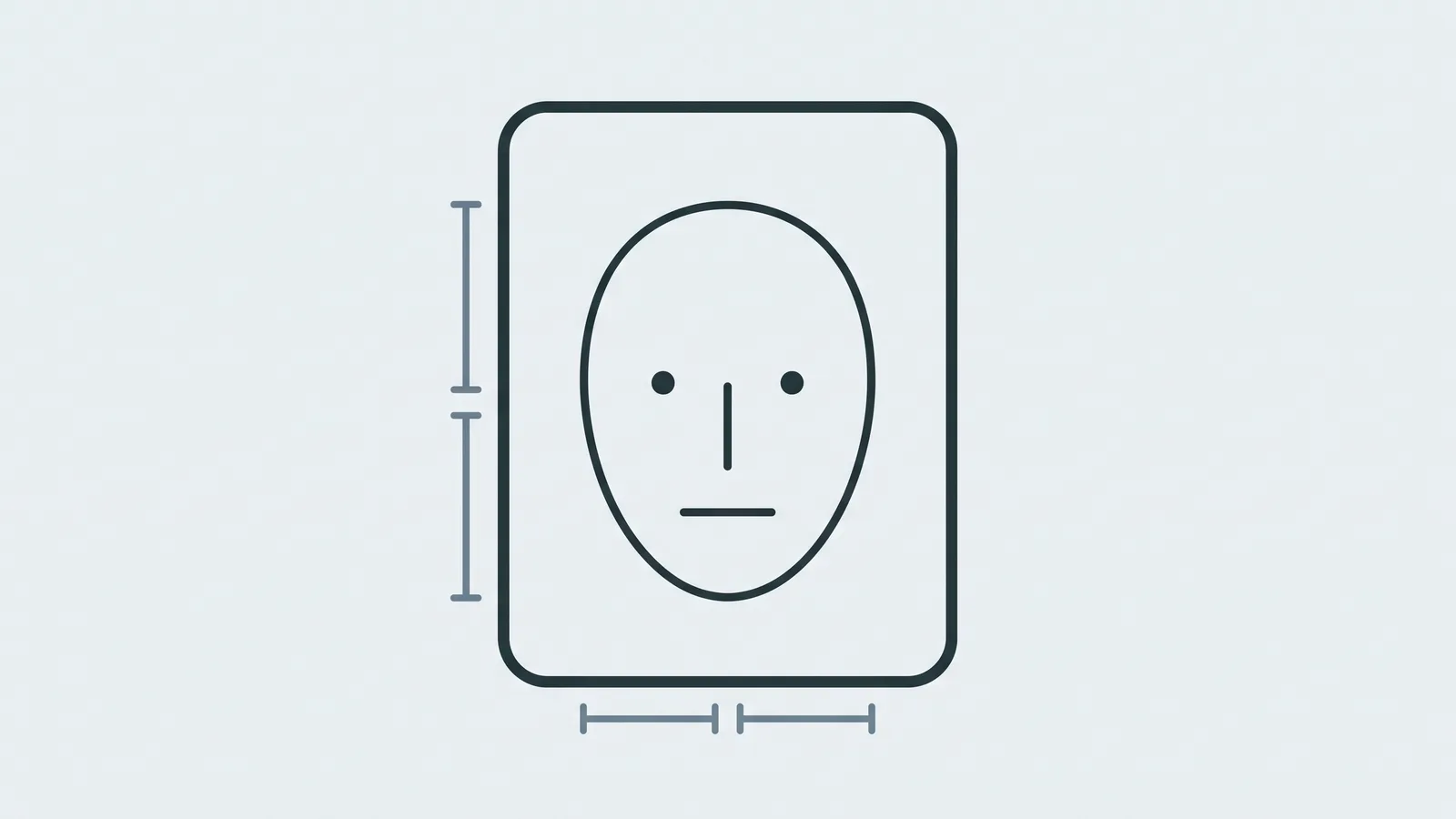
Most attractiveness tests give you a number and no explanation. A model looks at your photo, outputs a score, and you have no way to know what it measured or whether the answer means anything.
This one works differently. It measures 13 specific facial proportions using explicit geometry, shows you every measurement, tells you how confident it is in each one, and explains what the research does and does not support about how those proportions relate to attractiveness.
You will get real numbers. You will also get an honest account of their limits.
One photo. No account needed to see your measurements.
What gets measured
Thirteen proportions, each computed from landmark coordinates using a stated formula.
Eye region
- Canthal tilt, the angle between the inner and outer corner of each eye
- Brow position and shape, including brow-to-eye distance and apex placement
- Interpupillary distance
Midface
- Midface ratio, height against width
- Facial width-to-height ratio
- Bizygomatic width, the distance across the cheekbones
Lower face
- Gonial angle, the angle at the corner of the jaw
- Bigonial width, the distance between the jaw corners
- Lower third subdivision, lip and chin proportion
Whole face
- Facial thirds, the three vertical sections of the face
- Face length-to-width ratio
- Frontal width, across the forehead
- Facial symmetry, measured across paired landmarks
Each measurement is reported with the number, the range it sits within, and a confidence score based on how well your photo supported that particular measurement.
How the measurement works
The full method is documented on our methodology page. The short version:
We locate 478 facial landmarks using two independent models, and cross-check them against each other. Where the models disagree about a landmark position, that disagreement lowers the confidence score for any measurement depending on it.
We check the photo before measuring. Head rotation, lighting uniformity, sharpness, and occlusion are all assessed. If your head is turned too far or the lighting is heavily directional, the scan asks you to retake rather than returning a bad number.
We calibrate to real-world scale using iris diameter. The horizontal visible iris diameter is one of the most consistent dimensions in human anatomy, close to 11.7mm across the adult population. That gives us a pixel-to-millimetre conversion, which means we can report actual distances rather than only ratios, and detect when a photo was taken too close to the camera.
Every measurement is deterministic geometry. No model outputs a rating. If you had the landmark coordinates and the formula, you could compute the same number by hand.
What the research actually says about facial attractiveness
This is the part most attractiveness tests skip, and it is the part that determines how seriously you should take any score.
There is real agreement about attractiveness
Attractiveness ratings are not arbitrary. When large groups of people rate the same faces, they agree with each other far more than chance would predict, and that agreement holds reasonably well across cultures and across age groups. Meta-analytic work on this is consistent: there is a shared component to attractiveness judgement, and it is not small.
Averageness is the most robust finding
Composite faces, made by digitally averaging many individual faces together, are consistently rated as more attractive than most of the individual faces that went into them. This effect has replicated well since it was first demonstrated in 1990 and is one of the more solid results in the field.
Averageness here does not mean plain. It means proportions close to the population mean, which tends to produce a face without any single feature that reads as unusual.
Symmetry matters, but less than people assume
Symmetry correlates with rated attractiveness, but the effect is modest, and part of it appears to be carried by averageness rather than symmetry itself. Perfectly symmetrical faces, when generated artificially, are often rated as slightly unsettling rather than more attractive.
Sexual dimorphism findings are inconsistent
The idea that more masculine male faces are reliably rated as more attractive has not held up well. Findings vary considerably between studies and populations, and several widely reported effects in this area, including cycle-dependent preference shifts, have had significant replication problems.
About half of it is personal taste
This is the finding that matters most for how you read your result.
Research on rater agreement finds that shared consensus explains only around half the variation in attractiveness ratings. The rest is individual taste, meaning the specific preferences of the specific person doing the looking. That component is not predictable from geometry, and it is not something a measurement can capture.
So even a perfect measurement of your face would tell you about roughly half of what determines whether a given person finds you attractive.
What this test cannot tell you
Whether you are attractive. Attractiveness is not a property of a face. It is a relationship between a face and the people looking at it, and about half of it is idiosyncratic to those people. A measurement can tell you where your proportions sit. It cannot tell you how you land.
How you look in motion. Every measurement here is taken from a still, neutral-expression photograph. People do not meet you as a still photograph. Expression, movement, voice, and manner carry an enormous amount of what registers as attractive, and none of it is measurable from a face at rest.
Anything about you as a person. Facial proportions do not predict personality, behaviour, intelligence, or capability. Where research has claimed otherwise, most notably around facial width-to-height ratio and aggression, the effects have been small and have replicated poorly.
What to change. A measurement tells you where you are. It does not tell you that somewhere else would be better.
What it is genuinely useful for
Establishing a baseline. If you are making changes, whether that is body composition, grooming, or a treatment, having measurements from before is more useful than trying to remember how you looked.
Ruling things out. Often the most valuable result is discovering that the feature you have been fixating on is unremarkable, and that something you had not considered is the actual driver of how your face reads.
Making styling decisions. Face shape, facial thirds, and jaw measurements map directly onto haircut, beard, and glasses choices. This is the most immediately actionable output.
Understanding your own face accurately. You are the worst-positioned person to assess your own face. You see it mirror-flipped every day, you have seen it thousands of times, and familiarity distorts perception in both directions. A measurement is not subject to that.
How this differs from other face rating apps
We do not use a single composite score as the headline. Composite scores are aggregation choices dressed up as findings. The weights are doing all the work, and the weights are never disclosed. We report individual measurements.
We show the method. Every formula, every landmark, every reference line is published on our methodology page. No other tool in this category publishes theirs.
We report confidence. Every measurement comes with an honest assessment of how reliable it is given your photo. Some of our measurements have structurally lower confidence than others, and we say which and why rather than presenting all thirteen as equally solid.
We do not compare you to a mask. Proportional overlay masks, usually built around the golden ratio, score deviation from a template derived from a narrow sample of faces. That measures distance from one group's average. It does not measure beauty.
We do not claim to measure attractiveness. We measure proportions. What those proportions mean is discussed honestly, including where the honest answer is that we do not know.
Taking a good photo
Measurement accuracy depends more on your photo than on anything else.
Distance. Arm's length or further, ideally around 60cm or more. Close-range photos distort the centre of the face outward, which corrupts every width measurement. The scan estimates your distance from iris size and warns you if it is too short.
Lighting. Flat and even, facing the light source. Directional light creates shadow on one side that reads as structural asymmetry.
Head position. Straight on, level, looking directly at the camera. The guided capture will hold you at the right position for three seconds before taking the frame.
Expression. Neutral. Not smiling, brows relaxed, mouth closed and unstrained.
Hair. Pushed back off the forehead. Hair over the hairline removes the reference point for facial thirds and total face length.
Glasses. Off. Frames obscure the eye corners and create false edges.
Privacy
Your photo is stored on infrastructure located in the EU. It is not used to train models, ours or anyone else's. We do not train facial analysis models at all. You can delete your photos and reports at any time. Full detail on our privacy page.
Frequently asked questions
Is there an accurate attractiveness test? Not for attractiveness itself. Roughly half the variation in how attractive people find a given face comes from individual taste rather than shared consensus, and that half is not predictable from geometry. What can be measured accurately is facial proportion, which is what this test does.
How does an attractiveness test work? The reliable ones locate facial landmarks and compute proportions between them using explicit formulas. Less reliable ones pass your photo through a model that outputs a score with no stated method, which cannot be checked or explained.
Is this test free? The scan and your measurements are free. The full report with detailed interpretation and personalised recommendations is part of the paid plan.
Why did another app give me a completely different score? Different apps measure different things with different conventions, and most do not disclose either. Beyond that, composite scores depend on how the individual measurements are weighted, and that weighting is a choice each app makes privately.
Can a photo really measure my face accurately? For proportions and ratios, yes, within stated error bounds, provided the photo meets the quality conditions above. For absolute millimetre distances, accuracy is limited by the scale reference, which carries a population variance of around four percent. For anything requiring depth, a single frontal photo is inherently limited, and we say so where it applies.
Does the test work for women? The measurements are not sex-specific and will be accurate. The interpretation, reference ranges, and styling recommendations are currently written for men, so parts of the report will be less relevant.
What is the ideal score? There isn't one, and we do not report against ideals. The target figures circulating online for these measurements generally come from small aesthetic preference studies or from classical artistic convention rather than from population data. We report where your measurement sits within observed adult ranges.
Related Face Shape Test · Canthal Tilt Calculator · Face Symmetry Test · How ASCNDED measures a face
See your own numbers.
Upload one photo and get your facial proportions, face shape, and a non-surgical plan in about 60 seconds.
Scan my face