How Facial Measurement Works, in Plain English
The measurement pipeline explained for a general reader: why we do not output a score, how two landmark models cross-check each other, and the anatomical trick that gives us real-world scale.
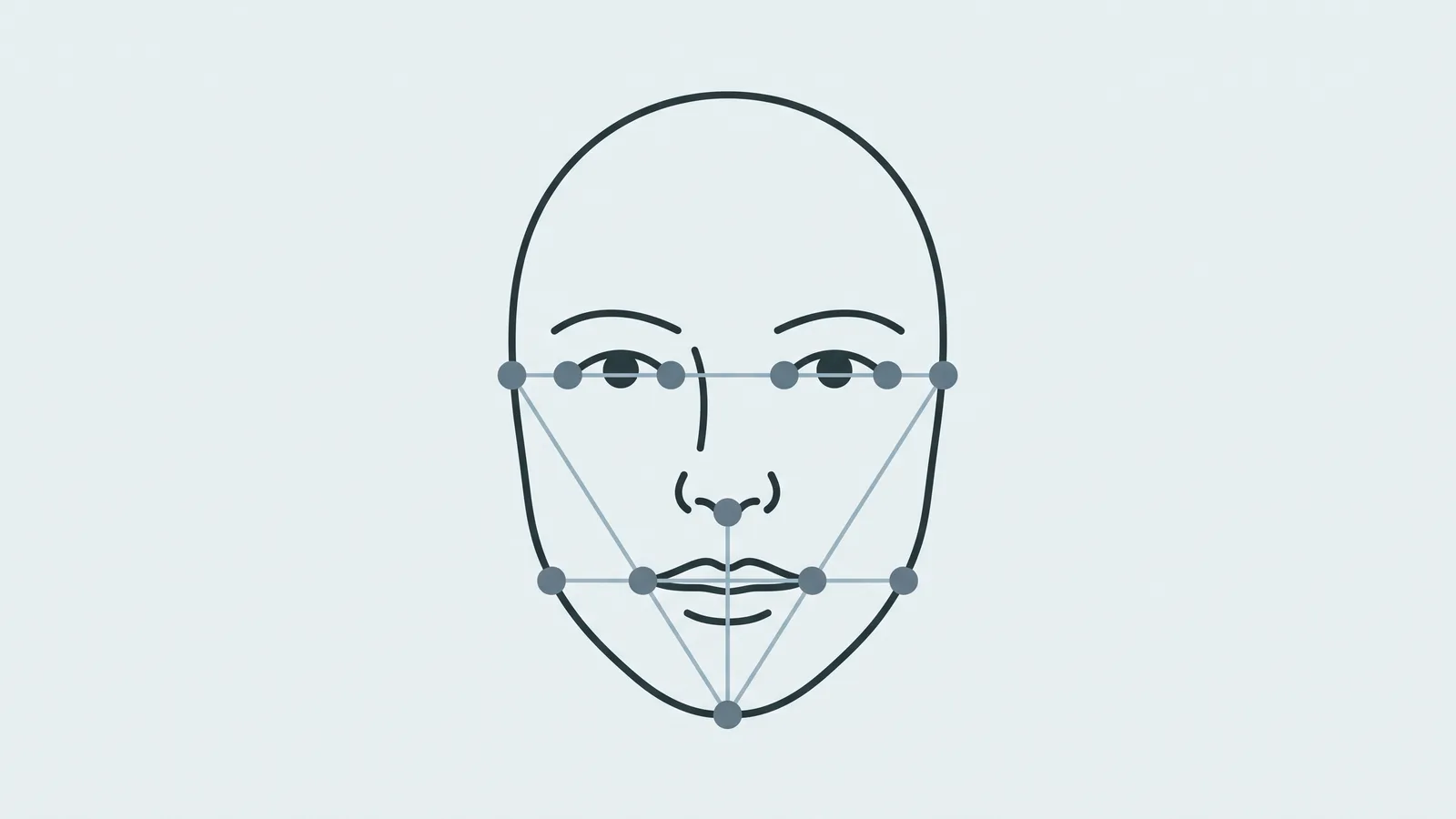
This is the plain-language version. The complete technical specification, with every formula, landmark, and threshold, is on our methodology page.
Most facial analysis tools work like this: a model looks at your photo and outputs a number. You cannot tell what it measured, why it arrived at that number, or how much to trust it. When it is wrong, nobody can explain why, including the people who built it.
We took a different approach, and this is what it involves.
The decision that shapes everything else
We do not use a model to rate your face. We use geometry to measure it.
Every number we report is produced by an explicit formula operating on landmark coordinates. Canthal tilt is the angle between two named points measured against a stated reference line. Gonial angle is the angle at a vertex between two vectors. If you had the coordinates and the formula, you could compute our numbers on paper.
This has a specific consequence that matters more than it sounds like it should: the measurement can be wrong in ways we can identify and fix. If a landmark is misplaced, we can see which one and why. A neural network that outputs "7.2" offers nothing to inspect. It cannot be audited, explained, or corrected. It can only be trusted or not.
We would rather be checkable than impressive.
Step one: the photo, which matters more than you think
More disagreement between facial analysis tools comes from photo conditions than from anything else.
A phone held at typical selfie distance is close enough that perspective distortion becomes substantial. The centre of your face projects larger relative to the edges, so your nose reads wider and your jaw compresses. Every width measurement is affected.
Directional lighting creates shadow on one side, and shadow edges are exactly the kind of high-contrast lines that landmark models mistake for anatomical features. This is the largest cause of false asymmetry in facial measurement.
A few degrees of head rotation, not enough to notice in the photo, shifts measurements by more than the differences people are trying to detect.
So the guided capture holds you at a target position for three seconds before taking a frame. That window lets the pose estimate stabilise, lets exposure and focus settle, and avoids sampling a transient head angle.
If you upload a photo instead, it goes straight to the quality checks, which is why uploads fail more often.
Step two: finding the landmarks, twice
Facial measurement depends on locating specific anatomical points. We use two independent models to do it, and run them in parallel.
RTMPose handles the contour landmarks: the jaw outline, the face perimeter, the region around the corner of the jaw. These are the hardest points to place accurately and the most consequential for jaw and width measurements. The model is trained on an aggregation of six facial landmark datasets, which gives broader coverage of pose, lighting, and demographic variation than any single dataset provides.
MediaPipe Face Mesh provides a dense 468-point mesh, extended to 478 with the iris model, which adds five points per eye covering the iris centre and boundary.
Why two models rather than one
Because agreement between two independent estimates is evidence, and disagreement is information.
The two models have different architectures, different training data, and different failure modes. Where they place a landmark in the same spot, we can be reasonably confident that landmark is well determined. Where they disagree, that region is genuinely ambiguous, and that ambiguity feeds directly into the confidence score attached to any measurement depending on it.
A single-model pipeline cannot distinguish a well-determined landmark from a confident guess. Two models can, and that distinction is most of what a confidence score should be built on.
Step three: checking before measuring
Before any measurement is computed, the capture goes through a set of quality checks. If it fails, you are asked to retake rather than being handed a number.
Head pose is estimated and decomposed into yaw, pitch, and roll. Roll, which is simple tilt, is corrected because it is a pure in-plane rotation. Yaw and pitch are not correctable from a single view, because they change projected distances non-linearly, so beyond a threshold the capture is rejected.
Lighting uniformity is assessed across the left and right face regions. Heavily directional light does not necessarily fail the whole capture, but it drops symmetry confidence substantially and the result says so.
Contour coherence is the check we are most pleased with. Real facial contours are anatomically smooth, with bounded curvature and consistent point spacing. When a landmark model partially fails, usually from occlusion or unusual lighting, the contour it produces shows characteristic irregularity: curvature spikes, uneven spacing, occasional self-intersection. Checking the jaw and perimeter landmark sequence for those signatures catches a category of failure that per-landmark confidence scores miss entirely.
Occlusion is checked per region. Hair over the forehead, glasses, hands. Occlusion does not fail the whole capture. It fails the measurements depending on the occluded region, which are reported as unavailable rather than estimated.
Resolution and sharpness have minimum thresholds. Below them, landmark precision degrades in ways the confidence model cannot characterise, so we reject rather than measure.
Step four: the iris trick
This is the part that is genuinely unusual, and it solves a problem most photo-based measurement quietly gives up on.
Everything measured so far is in pixels. Pixels have no real-world meaning. This is why almost every facial analysis tool can only give you ratios, never actual distances. A ratio between two measurements on the same face cancels out the unknown scale. An absolute measurement in millimetres requires knowing how big something in the photo actually is.
The horizontal visible diameter of the human iris is one of the most consistent dimensions in human anatomy. Across a wide adult population it sits at approximately 11.7 millimetres, with a standard deviation of around half a millimetre. This is the property Google's iris model was built to exploit, and it is used in ophthalmic imaging research as the standard reference for deriving pixel-to-millimetre conversions from photographs.
We already have the iris boundary landmarks. Dividing the known real-world diameter by the measured pixel diameter gives us a millimetres-per-pixel factor.
What that buys:
- Actual distances in millimetres, not just ratios
- An estimate of how far you were from the camera, which lets us detect and flag perspective distortion from close-range photos
- A cross-check on scale consistency between your two eyes, which is an additional signal for detecting head rotation
And the honest limitation: iris diameter varies between individuals by roughly four percent. That variance propagates into every absolute measurement, which is why our millimetre figures carry wider confidence bands than our ratio figures, and why ratios remain the primary form we report.
Anyone giving you millimetre measurements from a photograph without disclosing their scale reference either has not thought about it or is not telling you.
Step five: thirteen measurements
Thirteen proportions, each with a stated formula, a stated reference frame, and a stated dominant error source. Canthal tilt, gonial angle, facial thirds, lower third subdivision, midface ratio, facial width-to-height ratio, bizygomatic width, bigonial width, frontal width, symmetry, interpupillary distance, brow position, and face length-to-width ratio.
The full definitions are on the methodology page, including which landmarks are located directly and which are approximated from curvature. That distinction matters, and we publish it. The gonion, the corner of the jaw, is the significant one: on a soft tissue outline the jaw corner is a curve rather than a point, and its position is inferred. That is why gonial angle carries the lowest confidence of the thirteen, and we would rather say that than round it to one decimal place and hope.
Step six: confidence, and what it is built from
Every measurement carries a confidence score. It is not decoration and it is not a model's internal certainty repackaged.
It is computed from named inputs: how certain each required landmark was, how much the two models agreed in that region, whether the landmark was located directly or approximated, how much the output changes per unit of landmark displacement, and which capture quality flags apply to that specific measurement.
Low confidence comes in two kinds and we distinguish them. Sometimes it means retake the photo, and a retake fixes it. Sometimes the measurement is structurally difficult, and no photograph will fix it. Telling you which is more useful than a number.
What we deliberately do not do
We do not give you a single attractiveness score. A composite score is a weighted combination of measurements, and the weights determine the answer. Those weights are a choice someone made, not a fact about faces, and presenting the output as a measurement conceals that. We report the individual measurements.
We do not compare you to a mask. Proportional overlay masks, usually built around the golden ratio, score how far you deviate from a template derived from a narrow set of faces. That measures distance from one group's average. It does not measure beauty, and the golden ratio claim in facial aesthetics does not hold up well when applied consistently.
We do not report against ideals. The target figures circulating for these measurements mostly trace back to small aesthetic preference studies, to surgical planning norms from narrow populations, or to Renaissance artistic convention. Equal facial thirds, for example, comes from instruction for drawing a figure on a page. It was never a description of how real faces are distributed. We report where your measurement sits within observed adult ranges, and we say that the ranges are wide and vary by population.
We do not diagnose. Where something is better assessed by a professional, we say which specialty and stop there.
How to check us
Upload the same photo twice. The measurements will be identical, because everything from detection through metric computation is deterministic. If they are not, that is a bug and we want to know.
Check the geometry yourself. The formulas are published. Landmark coordinates operated on by stated formulas can be verified on paper.
Check the models. RTMPose and MediaPipe Face Mesh are both public. Run them on your own photograph and compare where the landmarks land.
Check where we disagree with other tools. The methodology page states, per metric, which convention we use and why another tool measuring the same face would get a different number. Usually it is the reference line or the landmark definition, and knowing which lets you compare properly instead of guessing.
Read the full methodology · Measure your face
Frequently asked questions
How accurate is facial measurement from a photo? For proportions and ratios under controlled photo conditions, good, within stated error bounds. For absolute millimetre distances, limited by the scale reference, which carries roughly four percent population variance. For anything requiring depth, a single frontal photo is inherently limited, and we say so per measurement.
Why does ASCNDED not give a score out of ten? Because a composite score's weights determine the answer, those weights are a choice rather than a finding, and no tool publishes them. Reporting individual measurements is more honest and more useful.
What are facial landmarks? Specific anatomical points located on a face, such as the corner of an eye or the centre of a pupil, used as reference positions for computing distances and angles. Some are precisely defined. Many, including the corner of the jaw, are not, which is a real limitation of the whole approach.
Why do you use two landmark models? Because agreement between two independent estimates tells you a landmark is well determined, and disagreement tells you the region is ambiguous. A single model cannot distinguish those two cases.
How does the iris measurement work? The horizontal visible iris diameter is close to 11.7mm across the adult population. Since we detect the iris boundary, we can convert pixels to millimetres using that known dimension, which also lets us estimate how far you were from the camera.
Is my photo used to train your models? No. We do not train facial analysis models at all, and your images are not used to improve any model, ours or anyone else's.
Related reading Full technical methodology · Why face rating apps give different scores · Measure your face
See your own numbers.
Upload one photo and get your facial proportions, face shape, and a non-surgical plan in about 60 seconds.
Scan my face