Facial Aesthetics: The Measurements That Actually Matter
A framework for facial aesthetics built on the measurements that describe a face: what each one captures, how they interact, which are modifiable, and where the ideals came from.
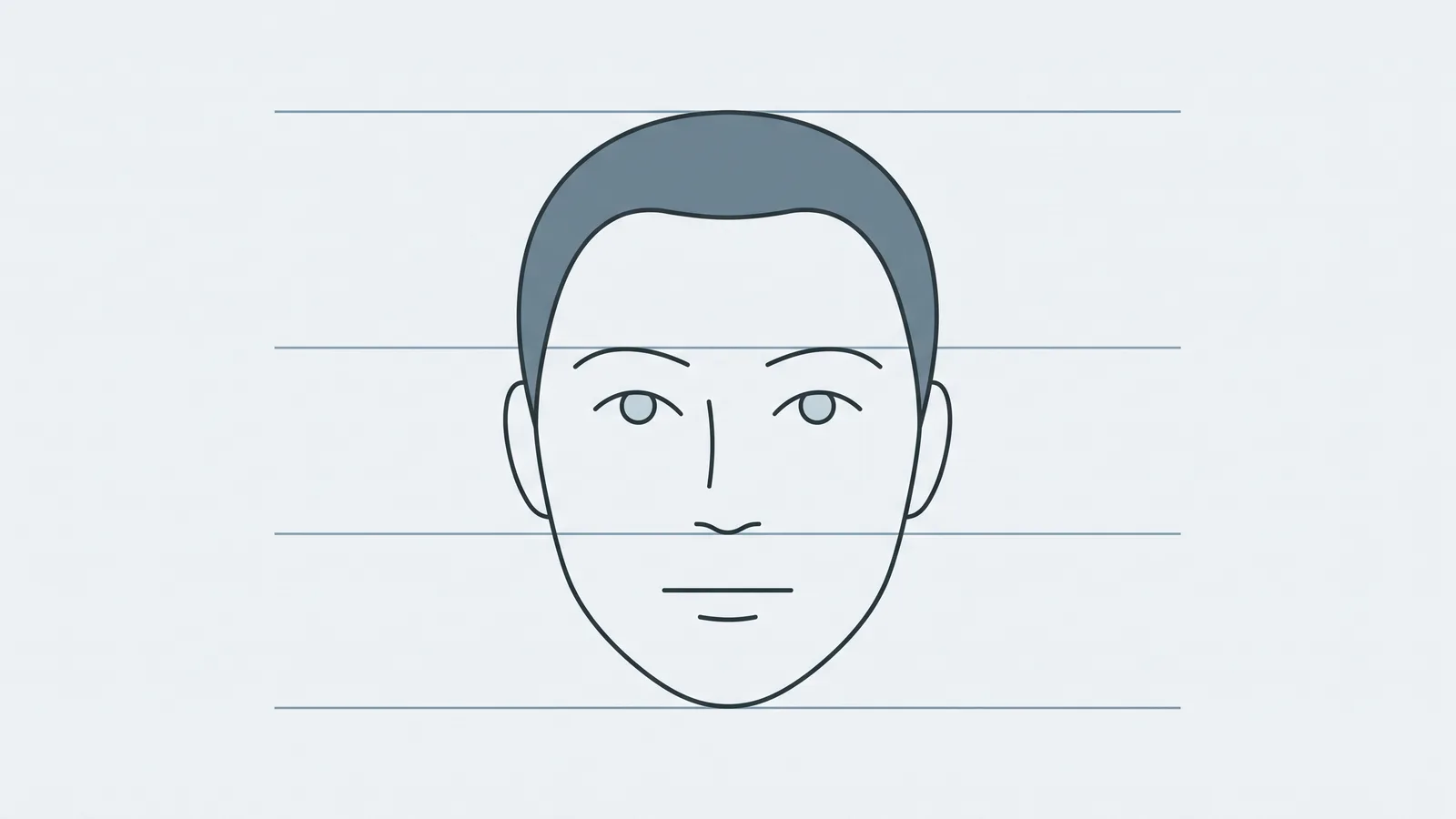
Facial aesthetics is the study of how facial structure and proportion relate to appearance. It sits across several fields: maxillofacial surgery, orthodontics, oculoplastics, dermatology, and anthropometry, each of which developed its own measurements for its own clinical reasons.
Most of what circulates online about this topic is those clinical measurements stripped of their context, attached to target numbers that were never population norms, and presented as a scoring system.
This is the framework version. What the measurements actually capture, how they interact with each other, which of them you can change, and where the "ideal" figures came from.
The three regions
Faces are conventionally divided into three horizontal sections, and it is a useful organising structure because the three behave very differently.
Upper third, hairline to brow. Dominated by forehead height, which in practice means hairline position. The least stable region across a lifetime, and the one where the measurement is most confounded by something that is not facial structure at all.
Middle third, brow to the base of the nose. Contains the eye region, the nose, and the cheekbones. The most stable region in adulthood and the least modifiable without surgery.
Lower third, base of nose to chin. Contains the mouth, jaw, and chin. The most functionally significant region, the most affected by dental structure, and the one where soft tissue makes the largest difference to appearance.
The classical convention holds that these should be equal. That convention comes from Renaissance artistic instruction, not from measurement of real populations, and real faces deviate from it constantly. More on that below.
What actually gets measured
Thirteen measurements cover most of what facial aesthetic assessment concerns itself with. Here is what each captures and why it exists.
Eye region
Canthal tilt. The angle between the inner and outer corner of the eye. Originates in oculoplastic surgery, where lateral canthal position matters for both function and reconstruction. Most adults fall between level and moderately positive, and it decreases with age as the supporting tendon loosens. Explained and measured
Brow position. Vertical distance from brow to eye, plus brow shape and apex placement. Determined largely by supraorbital ridge projection. One of the more sexually dimorphic areas of the skull.
Interpupillary distance. Distance between pupil centres. Primarily used as a normalising reference for other measurements rather than as an aesthetic quantity in itself.
Midface
Midface ratio. Midface height against width. Affects how the eye area reads relative to the mouth, and how broad or long the face appears independently of its individual features. Explained and measured
Bizygomatic width. The widest point across the cheekbones. Structural, and the reference width for several other ratios.
Facial width-to-height ratio. Bizygomatic width divided by upper face height. Notable mainly for the large body of behavioural claims attached to it, most of which have replicated poorly. Explained and measured
Lower face
Gonial angle. The angle at the corner of the jaw where the vertical branch of the mandible meets the horizontal body. From orthodontics and maxillofacial surgery. The single measurement most closely tied to perceived jaw definition, and the one most confounded by soft tissue. Explained and measured
Bigonial width. Distance between the two jaw corners. Determines whether a jaw reads wide or narrow, independently of how sharp its corners are.
Lower third subdivision. Lip and chin proportion within the lower third. More informative for most clinical purposes than the thirds themselves, and it is what orthodontic and maxillofacial assessment actually looks at.
Whole face
Facial thirds. The three sections above, as proportions of total face height. Explained and measured
Face length-to-width ratio. Total height against the largest width. The primary determinant of face shape classification. Find your face shape
Frontal width. Across the forehead at brow level. Relevant mainly through its ranking against the other two widths, which is what separates heart, diamond, and triangle shapes.
Facial symmetry. Deviation between paired landmarks. Everyone is asymmetric. Degree matters, presence does not. Explained and measured
How they interact, which is the part people miss
Individual measurements taken in isolation are close to meaningless, and this is the most common analytical error in this area.
A sharp gonial angle does not produce a defined jaw if body fat covers it. The measurement can be excellent and invisible.
A sharp gonial angle does not produce a strong jawline if the chin is recessed. From the side, chin projection carries more of the impression than the angle does.
Positive canthal tilt does not produce a striking eye area on its own. Brow position, upper lid exposure, and orbital vector all contribute, and three of those four depend on the shape of the bony socket rather than on the tilt.
A compact midface changes how eye size reads without any change to the eyes themselves, because there is less vertical space around them.
Facial thirds interact with the lower third subdivision. A long midface with a short lower third reads completely differently from a long midface with a long lower third, at the same overall proportions.
Bigonial width and gonial angle are independent. A wide jaw with soft corners and a narrow jaw with sharp corners are different faces, and a single "jaw score" would collapse them.
This is why a composite number is a poor summary. Aggregating interacting measurements into one figure requires weights, the weights determine the answer, and they are always a choice rather than a finding.
Where the "ideal" numbers came from
Almost every measurement above has a target figure circulating online, usually stated to one decimal place and presented as though it were a clinical standard. It is worth knowing where these actually originate, because it is generally one of three places.
Classical artistic canon. Equal facial thirds is the clearest example. This is a proportional system taught in Renaissance workshops, with roots in Greek sculptural convention, for constructing an idealised figure on a page. It was explicitly ideal rather than descriptive, and modern anthropometric measurement finds substantial deviation from it in real populations.
Surgical and orthodontic planning norms. Cephalometric norms exist for good clinical reasons: a surgeon planning a jaw reposition needs reference values. But those norms were derived from specific populations, often decades ago, and were designed to guide treatment of functional problems rather than to grade normal faces.
Small aesthetic preference studies. Researchers show a panel a set of digitally manipulated faces and record which proportions get rated highest. This is legitimate research, and it tells you about that panel. It is a study of rater preference, not a population norm, and the panels are frequently small and demographically narrow.
The golden ratio deserves separate mention. The claim that facial attractiveness follows a ratio of approximately 1.618 is widely repeated and does not hold up well. Faces contain enough landmarks that some pair of them will approximate 1.618 in almost any face if you select the landmarks after looking. Applied consistently, the correlation with rated attractiveness is weak. The proportional masks sold on this basis measure deviation from a template derived from a narrow sample.
What does have research support is averageness, meaning proportions close to the population mean, which has replicated well since 1990. And symmetry, more weakly. Neither is a specific target number, and both have modest effect sizes.
What is modifiable
The single most useful division in this entire subject, and it is rarely made cleanly.
Skeletal, meaning fixed without surgery
Gonial angle. Bizygomatic width. Bigonial width. Midface height and ratio. Orbital depth and brow ridge projection. Facial thirds, with one exception below. Canthal tilt.
In adulthood these do not change. Growth is complete, sutures are fused, and altering them requires cutting bone or adding implants.
Dental and orthodontic, meaning changeable with clinical treatment
Lower third height. Lip position and projection. Bite-related lower face proportion. Chin height.
This is the exception to the skeletal category and it is a genuinely large one. Orthodontic treatment and orthognathic surgery can change lower face proportion in ways nothing else non-surgical can, and it is the area where a functional indication most often exists alongside the aesthetic one.
Soft tissue, meaning changeable by you
Facial fat distribution, which affects apparent gonial angle, bizygomatic width, jaw definition, and eye area. Periorbital fluid, which affects the eye region day to day. Skin quality, which affects perceived age and health more than most structural measurements do. Masseter bulk, which affects lower face width. Submental fat.
This is where nearly all achievable change lives, and it is the category that gets least attention, because it is unglamorous.
Presentational
Hair, facial hair, brow shape, glasses, and how clothing frames the face and neck. Not measurements at all, and they change how a face reads substantially, immediately, and reversibly.
The measurement that is not in the list
Every measurement above is taken from a still, neutral-expression photograph.
People do not meet you as a still, neutral-expression photograph. Expression, movement, eye contact, voice, and manner carry an enormous share of what registers as attractive, and none of it appears in any of these numbers.
This is not a caveat added for balance. It is the largest single limitation of the whole framework, and it is why photograph-based assessment systematically underestimates people who are animated and overestimates people who photograph well.
The measurements describe the structure. They do not describe the face as anyone actually encounters it.
What this is genuinely useful for
Styling decisions. Face shape, facial thirds, and jaw measurements map directly onto haircut, beard, and glasses choices. This is the most immediately actionable output and the one where knowing your numbers changes what you do tomorrow.
Establishing a baseline. If you are making changes, measurements from before are more useful than memory.
Ruling things out. The most common result of measuring properly is discovering that the feature you were fixating on is unremarkable and something else is doing the work. That prevents expensive decisions made on bad information.
Clinical planning, which is what most of these measurements were developed for, in consultation with a surgeon or orthodontist assessing a functional problem.
What it is not useful for is producing a verdict. Roughly half of attractiveness judgement comes from the individual taste of whoever is looking, which no measurement predicts, and the shared half is not resolvable to a decimal point from one photograph.
Measure your proportions · How we measure
Frequently asked questions
What is facial aesthetics? The study of how facial structure and proportion relate to appearance. It draws on maxillofacial surgery, orthodontics, oculoplastics, and anthropometry, and its measurements were mostly developed for clinical planning rather than for grading normal faces.
What are the ideal facial proportions? There is no established set. The target figures in circulation come from classical artistic convention, from clinical planning norms derived from specific populations, or from small aesthetic preference studies. Averageness, meaning proportions near the population mean, has the best research support, and it is not a specific number.
Does the golden ratio apply to faces? Not reliably. Faces contain enough landmarks that some ratio will approximate 1.618 in almost any face if the landmarks are chosen after the fact. Applied consistently, the correlation with rated attractiveness is weak.
Which facial measurement matters most? None in isolation. They interact, and a measurement that looks favourable can be entirely invisible for reasons unrelated to it. Gonial angle is the most discussed and the most confounded by soft tissue coverage.
Can facial proportions be changed? Skeletal proportions are fixed in adults without surgery. Lower face proportion can change through orthodontic and jaw surgery. Soft tissue, which affects how every skeletal measurement reads, is substantially modifiable and is where nearly all achievable change sits.
Is facial aesthetics a real field? Yes, as a clinical concern within surgery, orthodontics, and dermatology, where proportional assessment guides treatment planning. What circulates online is largely that vocabulary detached from its clinical purpose.
Related reading Facial harmony explained · Looksmaxxing: what works and what doesn't · How we measure a face
See your own numbers.
Upload one photo and get your facial proportions, face shape, and a non-surgical plan in about 60 seconds.
Scan my face