Facial Harmony: Why Individual Features Do Not Explain a Face
Facial harmony explained: why measurements interact, the six pairings that matter most, and why a single feature almost never accounts for how a face reads.
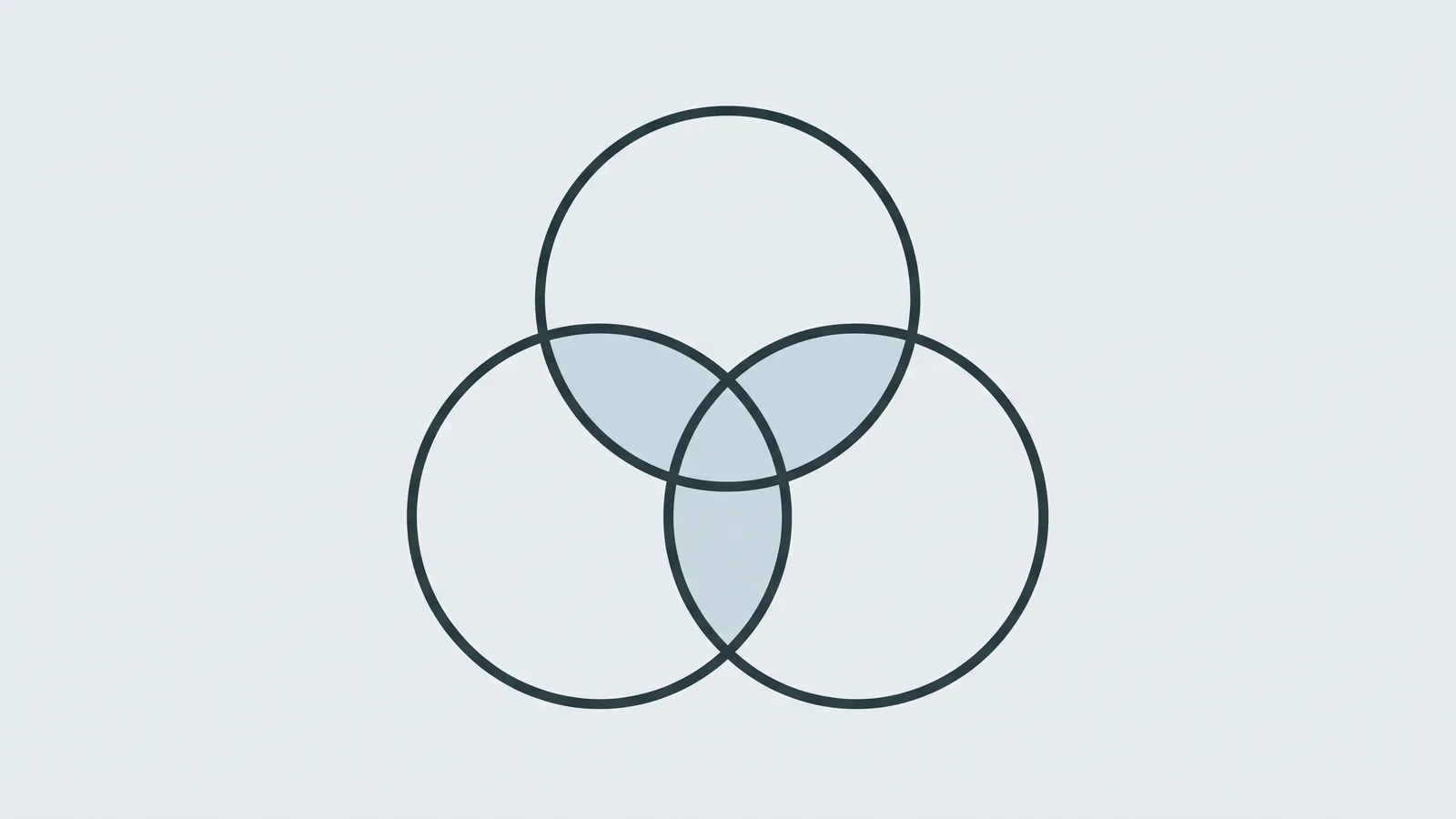
Facial harmony describes how well the parts of a face relate to each other, rather than how any single part measures on its own.
It is the concept that most online facial analysis discussion is missing, and its absence is the reason so much of that discussion goes nowhere. People measure one feature, find a number they dislike, and conclude they have located their problem. Usually they have not, because the feature was never operating alone.
The idea in one example
Two men have identical gonial angles. Sharp, well within the range anyone would call defined.
The first reads as having a strong jaw. The second does not.
The difference could be any of the following, and often several at once:
- The second carries more submental fat, so the angle is covered
- The second has a recessed chin, so from the side the jaw has no forward anchor
- The second has a narrower bigonial width, so the jaw is sharp but small
- The second has a long lower third, so the jaw sits in a different proportional context
- The second has a thinner neck, so there is less contrast at the jaw-neck junction
The gonial angle is identical. The measurement was accurate. It just did not determine the outcome, because it never does on its own.
This is what facial harmony means in practice. It is not a mystical concept about balance and beauty. It is the observation that facial measurements interact, and that reading any of them in isolation produces wrong conclusions.
The pairings that matter most
Six interactions account for most of what people misdiagnose.
Gonial angle and soft tissue coverage
The single most consequential pairing.
A photograph measures your jaw's soft tissue outline, not your mandible. Submental and buccal fat sit directly over the angle and fill it in. Photo-based gonial angle and a clinical lateral cephalogram routinely disagree by ten degrees or more for exactly this reason.
What this means: most people concerned about their gonial angle are observing their body composition. The bone underneath is usually ordinary and usually not the limiting factor.
Gonial angle and chin projection
From the front, the angle dominates. From the side, chin projection dominates.
A sharp angle with a recessed chin does not read as a strong jawline from any angle where profile matters, which includes most of how people actually see you. Conversely, good chin projection with a moderately soft angle often reads perfectly well.
What this means: if you are assessing your jaw from front-facing photos only, you are assessing half of it. And chin projection is a considerably smaller surgical problem to address than jaw angle, if it comes to that.
Canthal tilt and the rest of the eye area
Canthal tilt gets treated as though it were the whole eye region. It is one of four traits, and arguably not the most influential.
Brow position, upper eyelid exposure, and orbital vector all contribute, and three of those four depend on the shape and depth of the bony socket rather than on where the lateral canthus sits.
What this means: someone with positive canthal tilt, a high brow, heavy upper lid exposure, and a negative orbital vector has an eye area that reads nothing like the look they were aiming for, despite having the trait they measured. Full breakdown
Midface ratio and eye area perception
Two people with identical eye measurements can have noticeably different-looking eye regions.
A compact midface brings the eyes and mouth closer together relative to face width, which leaves less vertical space around the eye and makes it read as more prominent. A long midface does the reverse.
What this means: if your eyes read as small and your eye measurements are unremarkable, the midface is the likely explanation, and it is not something anyone would find by measuring eyes.
Facial thirds and the lower third subdivision
The three main sections tell you less than the subdivision of the lower one.
A long midface with a short lower third reads completely differently from a long midface with a long lower third, at identical overall proportions. Within the lower third, the relationship between upper lip height and chin height carries most of the perceptual weight, which is why orthodontic and maxillofacial assessment focuses there.
What this means: a facial thirds result that looks unbalanced often becomes explicable once the lower third is examined properly.
Bigonial width and gonial angle
Independent, and frequently conflated.
A wide jaw with soft corners and a narrow jaw with sharp corners are different faces. One reads heavy and undefined, the other reads sharp but slight. Both would receive a mediocre score from anything trying to summarise "jaw quality" as a single number, despite being opposite problems requiring opposite responses.
What this means: any composite jaw score is discarding the information you actually need.
Why composite scores fail here
This is the practical consequence of everything above.
If measurements interact, then combining them into a single number requires deciding how much each one counts and how it should be adjusted for the others. Those weights determine the answer entirely, they are a choice rather than a finding, and no tool that produces a score publishes them.
Worse, a single score collapses distinguishable situations into the same output. The wide-soft jaw and the narrow-sharp jaw get similar numbers. So do the man whose gonial angle is covered by fat and the man whose gonial angle is genuinely obtuse, even though one of those is fixable in six months and the other is not fixable without surgery.
A score is worse than useless in that case. It is actively misleading, because it looks like information.
The alternative is reporting the individual measurements and describing how they interact, which is more work to read and considerably more useful.
Averageness, which is the closest research equivalent
There is a finding in attractiveness research that connects to this idea.
Faces made by digitally averaging many individual faces are consistently rated as more attractive than most of the faces that went into them. This has replicated well since it was first demonstrated in 1990 and is among the more robust results in the area.
Averageness does not mean plain. It means proportions near the population mean, which produces a face where nothing reads as unusual. Part of what that captures is exactly the harmony idea: features that are proportionate to each other rather than any one feature being exceptional.
Symmetry correlates too, more weakly, and part of its effect appears to be carried by averageness rather than by symmetry itself.
What does not have good support is the golden ratio, which is the framework most often invoked when people talk about facial harmony. Faces contain enough landmarks that some ratio will approximate 1.618 in almost any face if the landmarks are chosen after the fact, and applied consistently the correlation with rated attractiveness is weak. The proportional masks sold on that basis measure deviation from a template built from a narrow sample of faces, which is a measure of distance from one group's average rather than a measure of harmony.
How to actually use this
Measure more than one thing. A single measurement in isolation will mislead you most of the time. The interactions are where the explanation lives.
Check the soft tissue question first. For anything involving the jaw or the width of the face, ask whether you are measuring bone or coverage. The answer changes what you should do next entirely.
Look at profile as well as front. Chin projection and orbital vector both require it, and both are commonly the actual explanation for something someone has been trying to diagnose from a front-facing photo.
Be suspicious of any single explanation. If you have concluded that one feature is responsible for how your face reads, that conclusion is more likely to be wrong than right, and it is the specific error this whole article is about.
And note what none of the measurements capture. All of this is taken from a still, neutral-expression photograph. Expression, movement, eye contact, and manner carry an enormous share of what registers when people meet you, and no measurement of a static face includes any of it.
Measure your proportions · How we measure
Frequently asked questions
What is facial harmony? How well the parts of a face relate to each other proportionally, rather than how any individual feature measures on its own. It matters because facial measurements interact, and a feature assessed in isolation frequently leads to the wrong conclusion.
How do you measure facial harmony? There is no single harmony score, and any tool offering one is combining measurements using undisclosed weights. What can be done is measuring the individual proportions accurately and examining how they interact, which is more informative than a number.
Is facial harmony the same as symmetry? No. Symmetry is left-right correspondence. Harmony is about the proportional relationships between different features, which is a separate question. A perfectly symmetrical face can still have features that are proportionally at odds with each other.
Does the golden ratio measure facial harmony? Not reliably. The correlation with rated attractiveness is weak when the ratio is applied consistently, and the proportional masks built on it score deviation from a template derived from a narrow sample.
Why does my face look different from what my measurements suggest? Almost always an interaction. A good measurement can be invisible because of soft tissue coverage, or undermined by a related feature such as chin projection or midface proportion. Isolated measurements rarely explain the whole impression.
What is the most harmonious face shape? Face shape is a classification of proportions, not a ranking. Its practical use is choosing a haircut, beard, and glasses that suit your geometry. Find yours
Related reading Facial aesthetics: the measurements that matter · Gonial angle explained · Hunter eyes explained · How we measure a face
See your own numbers.
Upload one photo and get your facial proportions, face shape, and a non-surgical plan in about 60 seconds.
Scan my face