Hunter Eyes: What the Term Actually Describes
Hunter eyes broken into the four measurable traits behind the term: canthal tilt, brow position, upper lid exposure, and orbital vector. What is genetic and what is not.
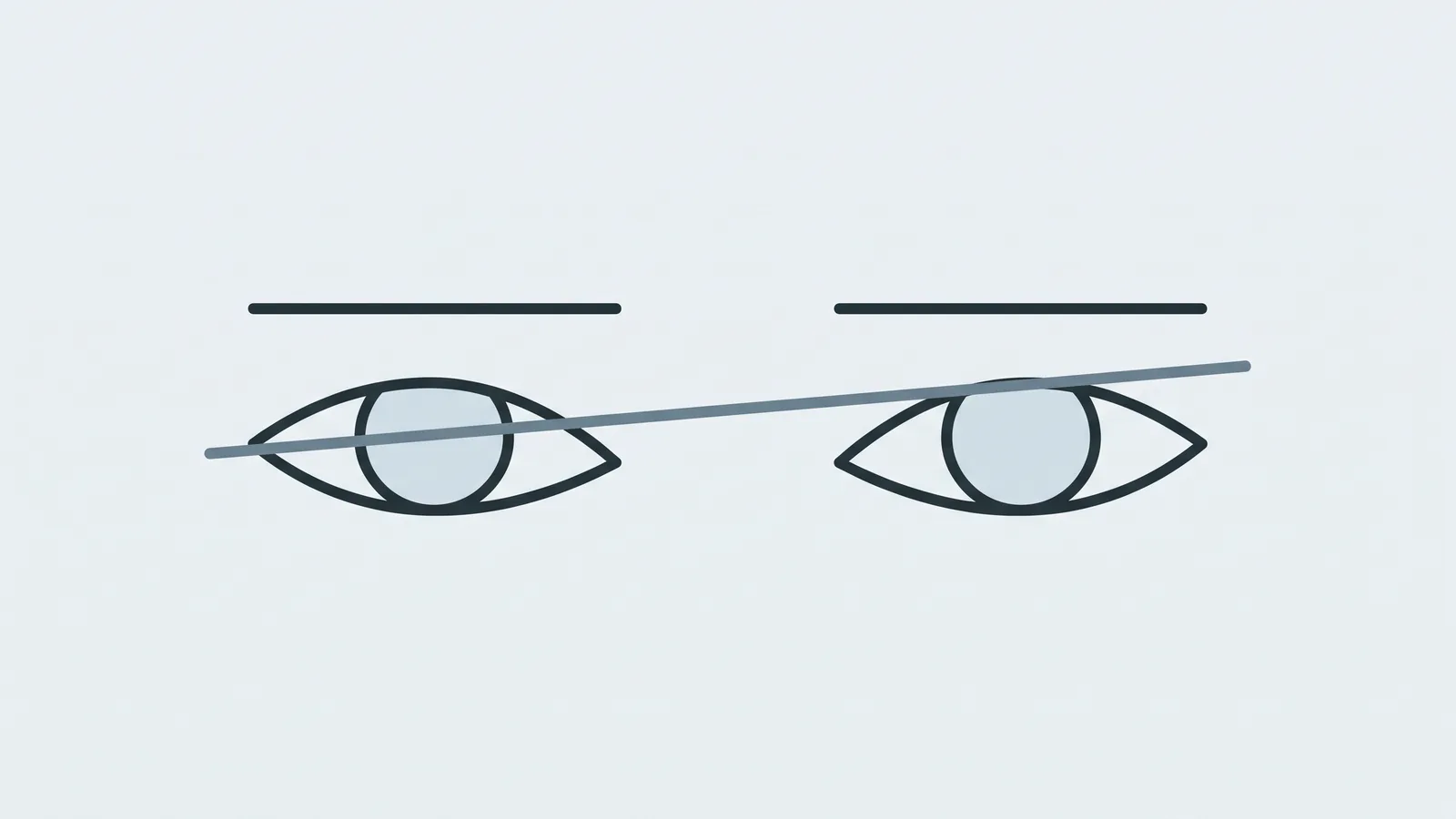
"Hunter eyes" is not one feature. It is a bundle of four separate traits that happen to often occur together: positive canthal tilt, low brow position, minimal upper eyelid exposure, and a positive orbital vector.
The term comes from looksmaxxing forums, not from anatomy. But every component it describes is a real, measurable thing, and once you separate them the topic becomes much clearer, including which parts are fixed and which are not.
Most content about hunter eyes treats it as a single property you either have or lack. That framing is the main reason people get confused about it.
The four components
1. Positive canthal tilt
The canthal tilt is the angle between the inner corner of your eye and the outer corner, measured against horizontal. Positive means the outer corner sits higher than the inner one.
Most adults fall somewhere between level and moderately positive, roughly 0 to 8 degrees, though population averages differ by several degrees between studies on different groups. Positive tilt is more common than negative in most measured populations.
This is the component most people focus on, and it is the one that gets discussed as though it were the whole thing. It is one of four.
2. Low brow position
How close the eyebrow sits to the eye. A shorter brow-to-eye distance is the defining feature of the "hunter" look and arguably contributes more to the overall impression than canthal tilt does.
This is largely determined by the shape and projection of the supraorbital ridge, the bony brow bone above the eye socket, and by where the soft tissue of the brow sits on it.
3. Minimal upper eyelid exposure
How much of the upper eyelid, the skin between the lash line and the crease, is visible when the eye is open and relaxed. Less visible lid means a more hooded, deeper-set appearance.
This is driven by brow bone projection, orbital depth, and the position of the eyelid crease, along with the amount of soft tissue in the upper lid.
4. Positive orbital vector
Whether the eye sits forward of or behind the cheekbone when viewed in profile.
Draw a line from the front surface of the eye down to the most prominent point of the cheek. If the cheek projects further forward than the eye, the vector is positive. If the eye projects further, it is negative.
A positive vector means the eye is supported and set within the socket. A negative vector means the eye sits relatively prominent, and it is associated with under-eye hollowing and visible tear troughs, because there is less bony support beneath the eye.
Orbital vector is determined by the projection of the infraorbital rim and the maxilla.
What the four have in common
They all trace back to the same underlying structure: the shape and depth of the bony eye socket, and the projection of the bones around it.
A deeper orbit with a projecting brow ridge and a well-projected infraorbital rim tends to produce all four traits together. That is why they cluster, and it is why the community treats them as one thing.
They cluster. They are not the same thing. Plenty of people have two or three of the four.
The sexual dimorphism part
There is a real anatomical basis to why this look reads as masculine.
The male craniofacial skeleton tends toward a heavier, more projecting supraorbital ridge and a somewhat deeper-set orbit than the female skeleton, on average. These are among the more reliable sexually dimorphic features of the skull, which is why forensic anthropologists use brow ridge morphology as one indicator when estimating sex from skeletal remains.
So the trait cluster does correspond to something real about male facial development.
What does not follow from this is that more of it is better. The research on whether more masculine male faces are rated as more attractive is inconsistent. Findings vary substantially between studies and populations, and several widely publicised effects in this area have replicated poorly. The confident claims you will see about masculine features and attractiveness are considerably stronger than the evidence supporting them.
Hunter eyes and prey eyes
The paired term you will encounter. "Prey eyes" describes roughly the inverse: neutral or negative canthal tilt, higher brow position, more visible upper eyelid, negative orbital vector, and a rounder, more open eye aperture.
Two things worth saying about this framing.
It is a spectrum, not two categories. Each of the four traits varies continuously. Almost everyone is a mix.
The naming is doing persuasive work. "Hunter" and "prey" are not descriptive terms. They are a value judgement embedded in vocabulary, which is a fairly common pattern in this space. The underlying measurements are real. The framing around them is a rhetorical choice, and you are allowed to reject it while still finding the measurements interesting.
How to tell what you have
Assessing this in a mirror does not work well. You are looking at a flipped image you have seen thousands of times, and the differences involved are a few degrees and a few millimetres.
Canthal tilt needs a front-facing photo measured against the interpupillary line rather than against the image horizontal. Head tilt is the main source of error, and a three degree tilt produces a three degree error on a measurement whose whole population range is about eight degrees wide.
Brow position is measured as vertical distance from the brow to the eye, normalised against another facial dimension so it is comparable.
Upper lid exposure is measured from a front photo with the eyes open and relaxed, and is sensitive to residual brow-raising, which almost everyone does unconsciously when being photographed.
Orbital vector requires a profile photo. It cannot be assessed accurately from the front, and any tool claiming to give you an orbital vector from a front-facing photo alone is inferring rather than measuring.
What actually changes these traits
Honest answer first: the bone determines most of it, and in an adult the bone does not change without surgery.
Here is each component, honestly.
Canthal tilt
The angle is set by where the lateral canthal tendon attaches to the orbital rim. Nothing done at home moves it.
Surgical: lateral canthoplasty and canthopexy reposition or tighten the tendon. These are established oculoplastic procedures, performed both reconstructively for age-related laxity and cosmetically. They carry real risk including asymmetry, altered lid position, scleral show, and dry eye, and revision is difficult. The person to speak to is a board-certified oculoplastic surgeon, meaning an ophthalmologist with subspecialty training in the structures around the eye.
Worth knowing: canthal tilt decreases with age as the tendon loosens. This is well documented. If yours is lower than you expected and you are past your thirties, that is the likely reason.
Brow position
Brow bone projection is fixed. Brow soft tissue position is not entirely.
Grooming has a genuine effect here and it is the most underrated item in this whole article. Brow shape, thickness, and where the lower edge sits change perceived brow height meaningfully, and it is free and reversible. Trimming the lower edge and keeping the brow full rather than thin both lower the apparent brow line.
Surgical: brow bone reduction or augmentation exists as part of facial feminisation and masculinisation surgery. Major procedures.
Upper lid exposure
Determined by orbital depth, brow projection, and lid crease position.
Non-surgical: periorbital swelling from poor sleep, high sodium, alcohol, or untreated allergies increases apparent lid fullness and puffiness. Addressing that is real and often noticeable, and it is the highest-yield thing available to most people.
Surgical: upper blepharoplasty removes excess upper lid skin. Performed for functional reasons when lid skin obstructs vision, and cosmetically. Done aggressively on someone who does not need it, it produces a hollowed, aged upper lid, which is a common bad outcome.
Orbital vector
Determined by infraorbital rim and maxillary projection. Skeletal, and fixed in adults.
Non-surgical: filler placed to support the tear trough and infraorbital region can change the appearance of a negative vector by adding volume where bone projection is lacking. This is a genuinely effective option and it is also one of the easiest areas to make worse. It belongs with an experienced injector.
Surgical: infraorbital rim implants, or midface advancement as part of orthognathic surgery, which is performed primarily for functional bite reasons.
Body composition
Worth its own mention. Significant body fat changes periorbital soft tissue and can obscure orbital structure. Reducing it often reveals eye area definition that was already there. This applies to all four traits and it is the only item on this page that is free, safe, and structurally effective.
What does not work
Mewing. Tongue posture acts, at most, on the maxilla and mandible. Three of the four hunter eye traits are determined by the orbital rim and supraorbital ridge, which tongue posture does not touch. Orbital vector involves maxillary projection, which is the closest theoretical connection, but there is no good evidence for adult skeletal change from tongue posture. Full breakdown
Eye exercises and facial yoga. No effect on tendon position, orbital depth, or bone. Repeated exaggerated expression can deepen dynamic lines around the eye.
Bonesmashing. Striking the brow or orbital region to induce remodelling. Do not. The orbital rim protects your eye, and the realistic outcomes of fracturing it are nerve damage, sinus injury, double vision, and permanent asymmetry. This region is one of the worst places on the body to attempt this, which is saying something.
Tape, patches, and lid-lifting devices. Temporary skin displacement lasting as long as the adhesive does.
Supplements marketed for eye area structure. Nothing taken orally repositions a tendon or remodels an orbital rim.
Sleeping in a specific position. Occasionally suggested for eye area shape. No structural effect, though it does affect fluid distribution on waking.
Some perspective
The eye area gets an outsized share of attention in this space relative to what it actually contributes.
Part of that is that the terminology is vivid and the differences are photographable. Part of it is that "hunter eyes" makes a good video title.
But the differences involved are genuinely small. A few degrees of canthal tilt. A couple of millimetres of brow height. These are real and they do affect how a face reads, and they are also much smaller than the weight assigned to them by content built to be watched rather than to be accurate.
Faces are also read as wholes, in motion, by people who are not measuring anything. Eye contact, expression, and how someone's face moves when they talk carry far more of what registers about a person's eyes than the static geometry does.
If you find yourself checking a feature repeatedly, comparing photos, or feeling significant distress about it, that experience is common in people who spend time in this space and it is worth talking to a GP or a therapist about. That is not a comment on your face. It is a comment on how much of your attention the loop is taking.
Frequently asked questions
What are hunter eyes? A term from looksmaxxing communities describing a combination of four traits: positive canthal tilt, low brow position, minimal upper eyelid exposure, and a positive orbital vector. It is not a clinical term, though all four components are real measurements.
Can you get hunter eyes naturally? The traits are determined largely by the shape and depth of the bony eye socket, which is set in adulthood. Reducing body fat, improving sleep to reduce periorbital swelling, and brow grooming all change how the eye area looks. None of them change the underlying structure.
What is the difference between hunter eyes and prey eyes? Prey eyes describes roughly the inverse traits: neutral or negative canthal tilt, higher brow position, more visible upper lid, and a negative orbital vector. Both are ends of a continuum rather than categories, and the naming carries a value judgement that is worth noticing.
Are hunter eyes attractive? The trait cluster corresponds to real sexually dimorphic features of the male skull. Whether more masculine male features are rated as more attractive is inconsistent across research, with several widely publicised findings replicating poorly. Confident claims in this area outrun the evidence.
Does mewing give you hunter eyes? No. Three of the four traits depend on the orbital rim and brow bone, which tongue posture does not affect. There is no good evidence for adult skeletal change from tongue posture generally.
Is canthal tilt the same as hunter eyes? No, and this is the most common confusion. Canthal tilt is one of four components. Someone can have positive canthal tilt with a high brow, a lot of visible upper lid, and a negative vector, which would not read as hunter eyes at all.
How do I know if I have a positive or negative orbital vector? It requires a profile view. From the side, compare how far forward the eye sits against the most prominent point of the cheek. If the cheek is further forward, the vector is positive. It cannot be assessed accurately from a front-facing photo.
Can surgery give you hunter eyes? Each component has a corresponding procedure: canthoplasty or canthopexy for tilt, brow bone work for projection, blepharoplasty for lid exposure, and rim implants or midface advancement for vector. These are significant procedures with real risk, and pursuing all of them to achieve a look defined by an internet community is a decision worth examining carefully with a surgeon who will push back.
Related reading Canthal tilt explained and measured · Negative canthal tilt · Looksmaxxing: what works and what doesn't · How ASCNDED measures a face
See your own numbers.
Upload one photo and get your facial proportions, face shape, and a non-surgical plan in about 60 seconds.
Scan my face