Mewing: What the Evidence Actually Supports
A straight account of mewing: the technique, where it came from, what happened to its main proponent, what research supports in children versus adults, and what the before-and-after photos really show.
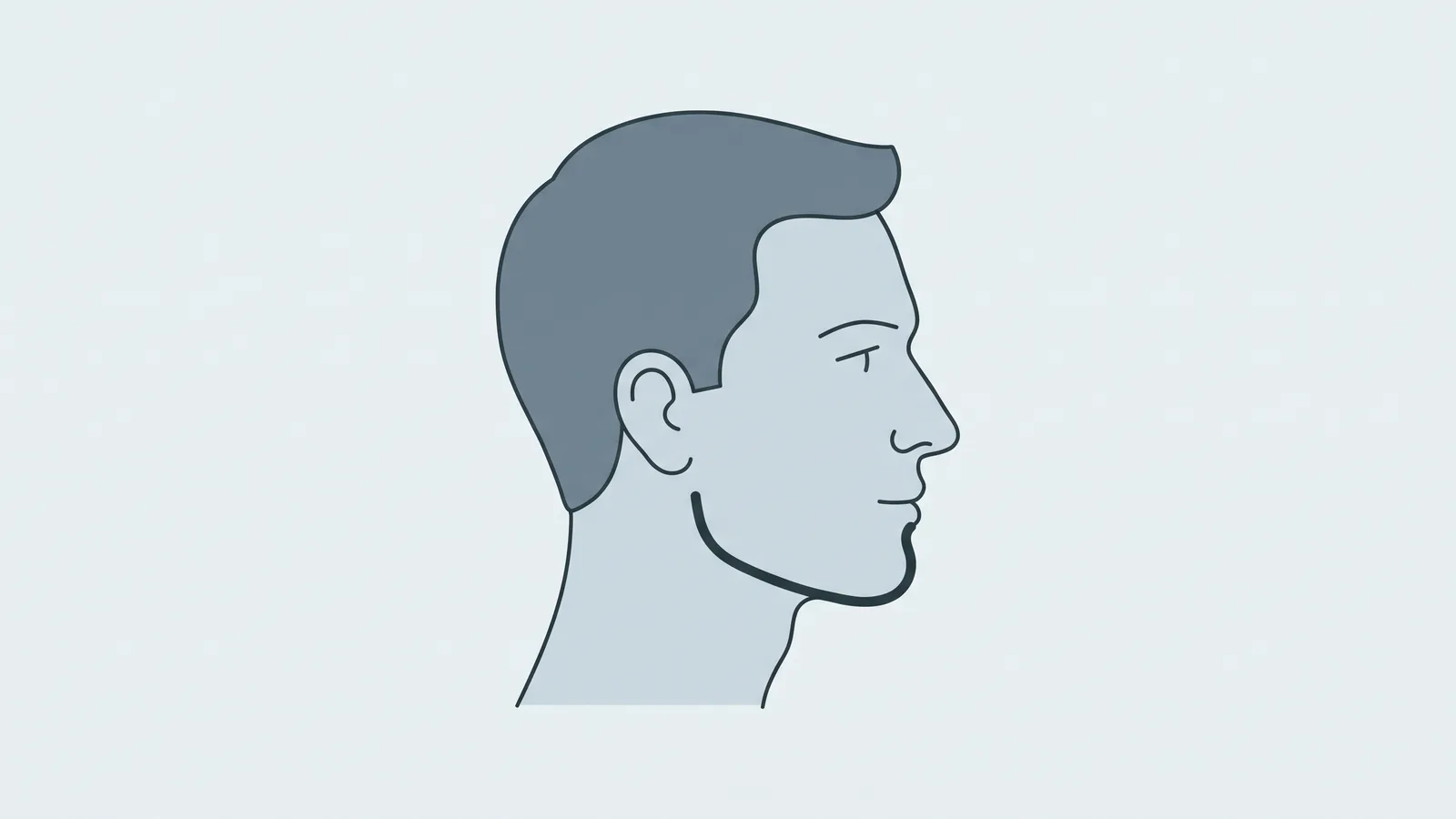
Mewing is holding your tongue flat against the roof of your mouth, with the claim that sustained posture reshapes your jaw and midface. It is the most searched technique in facial self-improvement, with billions of views on TikTok.
The short version: oral posture and breathing genuinely matter during childhood facial development, which is established orthodontics. There is no credible evidence that tongue posture reshapes an adult face. The technique's most prominent proponent was struck off the UK dental register in 2024. And the transformation photos are real photos of real changes that were mostly caused by something else.
Here is the whole picture.
Contents
- The technique
- Where it came from
- What happened to Mike Mew
- What the evidence supports
- Why adults are the sticking point
- What the before-and-after photos actually show
- Myofunctional therapy, which is different
- Hard mewing and the risks
- What to do instead
- FAQ
The technique
Descriptions vary, but the standard version is:
- The entire tongue rests against the palate, not just the tip. The posterior third is emphasised as the part most people fail to engage
- The tongue tip sits just behind the upper front teeth, not touching them
- Lips are sealed
- Teeth are lightly together or close, not clenched
- Breathing is through the nose
- The posture is held constantly, as a resting default rather than an exercise
"Hard mewing" is a variant involving deliberate forceful upward pressure. It is not part of the original description and it is where the injury reports come from. More on that below.
The claimed outcomes are a sharper jawline, forward maxillary growth, improved midface projection, better cheekbone definition, and improved breathing.
Where it came from
Mewing derives from orthotropics, a treatment approach developed by British orthodontist John Mew and promoted extensively by his son, Mike Mew.
The orthotropic theory holds that modern facial underdevelopment is caused largely by environmental factors: soft processed diets requiring less chewing, chronic mouth breathing, and poor oral posture during childhood. John Mew termed the resulting pattern "craniofacial dystrophy." The proposed remedy is guiding facial growth through oral posture and appliances rather than through conventional orthodontic tooth movement.
Orthotropics is not a specialty recognised by the NHS, the General Dental Council, or the British Orthodontic Society.
The term "mewing" itself was coined by online communities, not by the Mews, and refers specifically to the do-it-yourself tongue posture component stripped of the clinical appliances and supervision that orthotropics involves.
What happened to Mike Mew
This is a matter of public regulatory record and it is the single most relevant fact about the technique's credibility.
In November 2024, following a seven-year investigation, the Dental Professionals Hearings Service found that Michael Gordon Mew, who qualified in London in 1993 and ran the Orthodontic Health Clinic in Surrey, should be erased from the register of dental practitioners, as his fitness to practise was impaired by reason of misconduct. He was handed an immediate suspension order, the committee having found him a risk to public safety due to undertaking treatments with no objective evidence base.
The case centred on orthotropic treatment recommended to two six-year-old patients. The committee determined that treatment was not clinically indicated for either patient, as there was no objective evidence to support it. A 2017 YouTube video was also found to have made inappropriate or misleading claims. The hearing heard that Mew had stated on his YouTube channel that creating sufficient tongue space could influence facial growth and the expansion of the brain, and the committee found that statements implying these techniques could increase a child's intelligence were inappropriate and misleading. Expert witnesses testified that orthotropics is unsupported by scientific evidence.
Mew responded that the GDC "has offered as much scientific evidence for their approach as the Pope did in convicting Galileo," and argued that the council was more concerned with protecting the orthodontic industry than protecting children.
It is worth being clear about what this does and does not establish. A regulatory finding about a practitioner's treatment of two children is not by itself a scientific verdict on tongue posture. But the finding rested on expert evidence that the underlying approach lacks an evidence base, and that is the same question anyone searching for mewing is really asking.
What the evidence supports
Split the question in two, because the answer is different for each half.
In growing children and adolescents: plausible, and partly established
Craniofacial development in children is genuinely influenced by oral posture, breathing pattern, and function. This is not fringe. It is mainstream paediatric orthodontics.
Chronic mouth breathing, often driven by nasal obstruction, enlarged adenoids, or allergies, is associated in the orthodontic literature with a narrower palate, a longer lower face, and altered jaw development. Correcting the underlying airway problem in childhood is a legitimate clinical intervention with real effects.
The maxilla is still developing through the teens, and the midpalatal suture has not fully fused, which is why rapid maxillary expansion works in children and adolescents without surgery.
So the premise underneath orthotropics is not invented. What is contested is the specific claim that a self-directed tongue posture habit, without appliances or supervision, produces meaningful growth guidance, and how large any effect would be. There are no controlled trials on mewing specifically in this age range.
In adults: no
By roughly the early twenties, the midpalatal suture is fused and facial growth is complete. Changing the position of fused facial bones requires either sustained therapeutic force from appliances, or surgery. In adults, palatal expansion requires a surgically assisted or bone-anchored approach for exactly this reason, because the suture will not open otherwise.
Tongue rest posture applies a force orders of magnitude below what those interventions deliver, applied inconsistently, against bone that has stopped growing.
The published literature reflects this. Reviews looking at conservative facial rejuvenation techniques note that evaluation of mewing's efficacy is sparse and relies largely on anecdotal or low-level evidence. The American Association of Orthodontists has criticised mewing for lacking clinical validation. There is no body of controlled evidence demonstrating adult skeletal change from tongue posture, and the mechanical argument for why there would be is weak.
This matters because adults are almost everyone searching for it. The claims that spread on TikTok are adult claims, made to an audience hoping for adult results.
Why adults are the sticking point
Worth understanding mechanically, because it explains why this is not a case of evidence being merely absent.
Bone does remodel in response to mechanical load. That is real, and it is why orthodontic tooth movement works and why loaded bone strengthens. But remodelling responds to loads above a threshold, sustained over long periods, applied to bone with the biological capacity to respond.
Orthodontic appliances deliver continuous calibrated force over months to years and move teeth through bone. They do not move fused sutures. Jaw surgery moves bone by cutting it and fixing it in a new position.
Tongue rest posture is a light, intermittent load applied by a muscle against a palate. The comparison is not close, and no amount of consistency converts a sub-threshold load into a supra-threshold one.
What the before-and-after photos actually show
The transformation photos are often striking. Most of them are also real photographs of real people who genuinely look different. So what happened?
Body fat. By a wide margin the most common explanation. Someone who loses ten to twenty pounds over two years while also mewing will have a substantially more defined jawline, from the fat loss. Facial fat sits directly over the jaw and cheekbones, and removing it reveals structure that was already there.
Age. The demographic doing this is overwhelmingly 14 to 22. That is precisely the window in which male faces naturally mature: the jaw widens, the brow ridge develops, facial fat redistributes, and the face masculinises. Two years of ordinary development in a 16-year-old produces exactly the changes attributed to the technique.
Photo technique. Before photos are typically taken from below with poor lighting and a relaxed posture. After photos are taken from slightly above with the chin extended, better lighting, and the neck engaged. Camera angle alone changes apparent jaw definition dramatically. This is not always deliberate, but the direction of the bias is consistent.
Posture and neck engagement. Holding the head up and the tongue up does temporarily firm the submental area. This is a real, immediate, soft-tissue effect and it disappears when you relax. It is also the effect people photograph.
Grooming and body composition together. Most people who start mewing start other things at the same time. Attributing the combined result to the one novel-sounding component is an ordinary attribution error.
None of this requires anyone to be lying. It requires only that the most visible variable gets the credit.
Myofunctional therapy, which is a different thing
Worth separating clearly, because the two get conflated and one of them has evidence.
Orofacial myofunctional therapy (OMT) is a structured, clinician-led programme that retrains tongue, lip, and facial muscle function. It is aimed at function rather than appearance, and it is delivered by trained therapists with assessment and progression.
It has real evidence behind it for specific indications. Meta-analyses of randomised trials have found that OMT reduces apnoea events and improves sleep quality in adults with obstructive sleep apnoea, where it is used as an adjunct therapy. Systematic review evidence also supports its use in temporomandibular disorders for pain and function, though the quality of trials there is more mixed.
What OMT is not is a facial aesthetics intervention. Nobody delivering it clinically is claiming it reshapes an adult skeleton. The evidence supports it for airway and functional outcomes, and that is what it is prescribed for.
If your actual concern is chronic mouth breathing, snoring, jaw pain, or disrupted sleep, this is the route worth pursuing, and it starts with a doctor or dentist rather than with a video.
Hard mewing and the risks
Standard mewing, meaning resting your tongue on your palate and breathing through your nose, is not going to hurt you.
Hard mewing is a different matter. Deliberate forceful upward pressure, often combined with jaw clenching, is associated with reported problems including:
- Jaw and masseter tension
- Temporomandibular joint symptoms, including pain and clicking
- Tooth movement from sustained pressure, particularly flaring of the upper front teeth
- Headaches from sustained muscle tension
- Bite changes, occasionally requiring orthodontic correction
There is a second category of risk that is less discussed and probably more consequential. Obsessive practice. The technique is meant to be held constantly, which makes it unusually well suited to becoming a compulsion. Monitoring your tongue position continuously, checking your jaw in reflective surfaces, and photographing progress are all commonly reported by people who have taken it seriously, and they are also the behavioural pattern of appearance-focused anxiety.
If you find you cannot stop thinking about your tongue position, that is worth noticing.
What to do instead
If you want a more defined jaw, the honest ranking:
1. Body composition. The largest lever by a wide margin, and the one that actually produces the transformations attributed to mewing. Facial and submental fat sit directly over the jawline.
2. See a dentist or doctor if you have a functional problem. Chronic mouth breathing, snoring, disrupted sleep, or jaw pain are worth diagnosing properly. The causes, including nasal obstruction and sleep-disordered breathing, have real treatments.
3. Sleep and sodium. Both affect facial fluid retention and both change how the lower face looks day to day.
4. Facial hair. A beard shaped correctly can build a visual jaw corner that your bone structure does not provide. It is the highest-leverage non-permanent option available for the lower face.
5. Neck and shoulder development, and posture. Changes how the head and jaw read in proportion.
6. If you want to know what your jaw actually measures, measure it. Most people concerned about their gonial angle are observing soft tissue coverage rather than bone, and knowing which is genuinely useful. Measure your gonial angle
And if you want to rest your tongue on your palate and breathe through your nose, do it. It is free, it is probably mildly good for you, and the only real cost is if it displaces things that work.
Frequently asked questions
Does mewing actually work? Not for adults, in the sense people mean. There is no credible evidence that tongue posture reshapes adult facial bone, and the mechanical case for why it would is weak. Oral posture and breathing do influence craniofacial development in growing children, which is established orthodontics, but that is a different claim.
How long does mewing take to work? No timeframe has been established, because no effect has been established in adults. Timeframes circulating online, typically six months to two years, correspond to how long it takes for body composition and natural facial maturation to produce visible change.
Can mewing change your jawline? It can temporarily firm the area under the chin while you are actively holding the posture, which is a soft tissue effect that stops when you relax. It does not change the mandible.
Is mewing safe? Resting your tongue on your palate is harmless. Hard mewing, meaning deliberate forceful pressure, is associated with jaw tension, TMJ symptoms, tooth movement, and bite changes. The bigger risk for most people is that it becomes compulsive.
Who is Mike Mew? An orthodontist who promoted orthotropics and the practice that became known as mewing. He was erased from the UK dental register in November 2024 following a General Dental Council misconduct hearing, which found him a risk to public safety for undertaking treatments with no objective evidence base. He disputes the ruling.
Does mewing work at 18, 20, 25? Facial growth is essentially complete by the early twenties and the midpalatal suture fuses around that period. Any age at which someone is still growing offers more plausibility than adulthood, but there are no controlled trials on mewing at any age.
What is the difference between mewing and myofunctional therapy? Myofunctional therapy is a clinician-led programme targeting oral muscle function, with evidence supporting its use in obstructive sleep apnoea and temporomandibular disorders. Mewing is a self-directed tongue posture habit promoted for aesthetic outcomes. The first is treatment, the second is not.
Are mewing before and after photos real? The photographs are usually genuine. The attribution usually is not. Body fat loss, natural facial maturation in teenagers, camera angle, and lighting account for most of what those photos show.
Related reading Gonial angle explained and measured · Looksmaxxing: what works and what doesn't · How to improve your jawline · How we measure a face
See your own numbers.
Upload one photo and get your facial proportions, face shape, and a non-surgical plan in about 60 seconds.
Scan my face