How to Improve Your Jawline: What Actually Changes It
The honest ranking of what defines a jawline, why body fat is the answer for most people, why chewing gum backfires, and what the surgical options actually are.
For most people asking this, the answer is body fat, and everything else is a distant second. That is not a brush-off. It is the finding that most jawline content avoids, because it is slow, unexciting, and impossible to sell a product against.
Here is the full picture: what actually determines jaw definition, what you can change, what backfires, and what the surgical options are.
What a jawline is made of
Four things determine whether a jaw reads as defined. Separating them explains why generic advice fails so often.
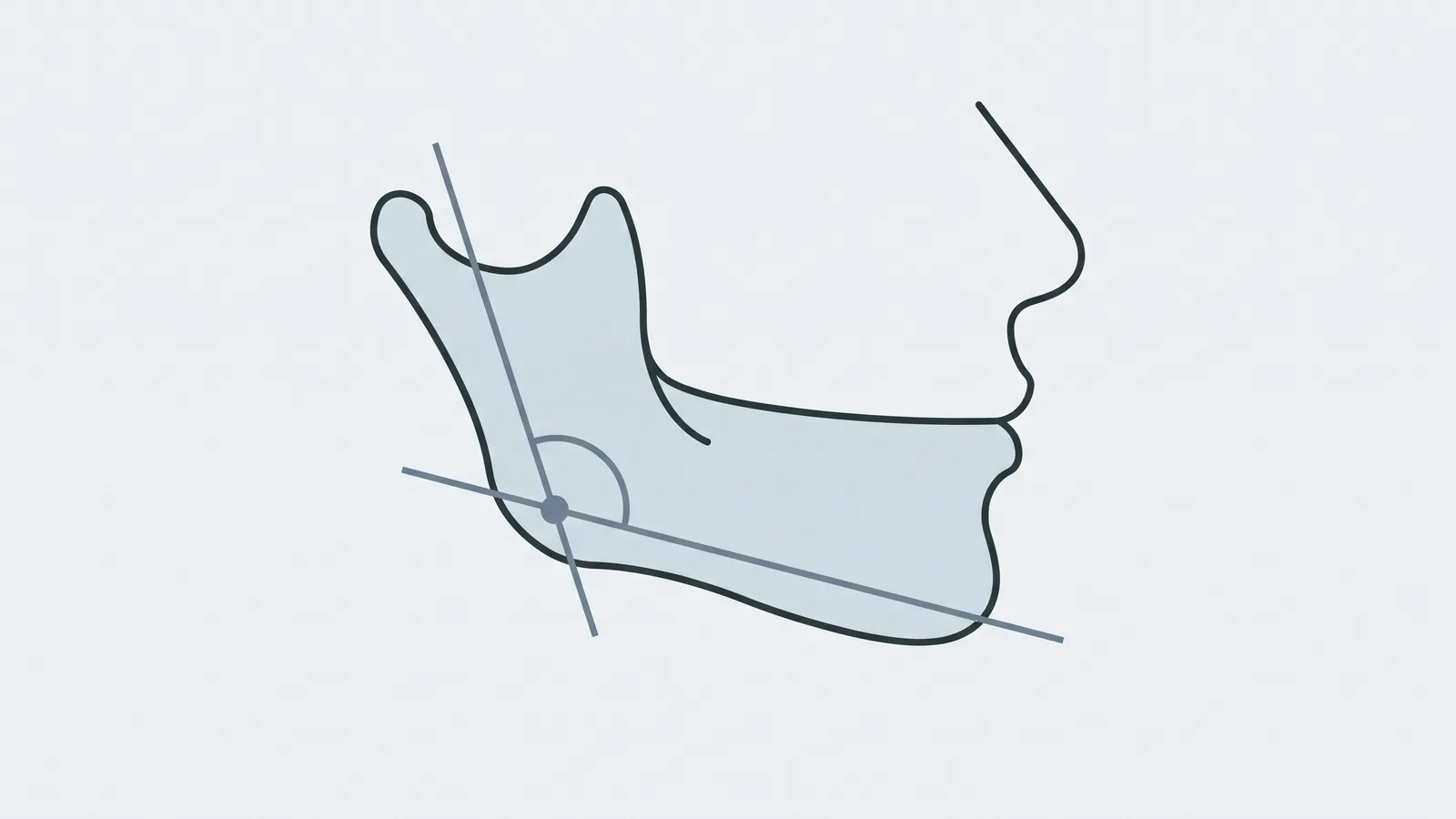
Gonial angle. The angle at the corner of the jaw, where the vertical branch of the mandible meets the horizontal body. Smaller means a sharper corner. This is the measurement most closely tied to what people mean by a defined jaw, and it is fixed in adults. Explained and measured
Bigonial width. How far apart the two jaw corners are. Determines whether a jaw reads wide or narrow, independently of how sharp the corners are. Also skeletal.
Chin projection. How far the chin comes forward in profile. From the side this carries more of the impression of a strong jawline than the gonial angle does, and a recessed chin will undermine an otherwise good jaw completely.
Soft tissue coverage. Subcutaneous fat over the jaw, submental fat under the chin, skin laxity, and masseter bulk. This is the only one of the four that is substantially under your control, and it determines whether the other three are visible at all.
The key point: a sharp gonial angle covered in soft tissue does not read as a defined jaw. The measurement can be excellent and completely invisible. Most people concerned about their jaw have a perfectly ordinary mandible under a layer that is obscuring it.
What actually works
1. Body fat, by a wide margin
Submental fat, the fat under the chin, is one of the areas where fat accumulates readily and one of the last to go. It sits directly over the jawline and fills in the angle between the jaw and the neck.
Reducing body fat removes it and reveals the bone underneath. There is no way to target it specifically, because spot reduction does not work, so this means overall body fat reduction.
This is the entire explanation for the majority of dramatic jawline transformations you have seen. The bone did not change. The layer over it did.
There is a caveat worth stating, because it gets pushed too far. Below a certain point, continuing to lose fat stops helping and starts hurting, because the face loses the fat pads that give it structure. Very low body fat produces a gaunt look, not a chiselled one, and the pursuit of extreme leanness for facial definition is a common route into disordered eating. The useful range is normal-lean, not competition-lean.
2. Fluid retention
Faster than fat loss and genuinely visible.
Sodium intake, alcohol, poor sleep, and untreated allergies all contribute to facial fluid retention, which softens the jaw and submental area. Addressing them produces visible change within days.
Temporary, and real. If your jaw looks different on different mornings, this is why.
3. A beard, shaped correctly
The highest ratio of visible change to effort available, and reversible.
A beard shaped with a straight cheek line and squared corners at the chin creates a visual jaw angle where your bone structure has a curve. It is the closest thing to a non-permanent structural change that exists for the lower face.
The details matter more than the length. Keep the cheek line high and straight rather than following your natural growth curve. Square the bottom corners rather than rounding them. Keep the neckline about two finger widths above the Adam's apple, following a curve behind each ear, and never trim along the jawbone itself, which is the most common mistake and shortens your visible lower face.
4. Neck and shoulder development
Changes how the jaw reads in proportion. A thicker neck and developed traps alter the visual relationship between jaw and neck, and posture work reduces the appearance of submental fullness by changing head position.
Real, moderate, and slower than fat loss.
5. Skin
Skin laxity affects the jawline directly, and it increases with age and with sun exposure. Sunscreen is the single most effective long-term intervention for maintaining jaw definition, which is not how anyone thinks about sunscreen.
What backfires
Chewing gum, mastic gum, and jaw trainers
These do something. It is not the thing you want.
Sustained heavy chewing enlarges the masseter, the muscle attaching at the corner of your jaw. That is a genuine, documented effect, and it is why people report their jaw feeling different.
But masseter hypertrophy adds width to the lower face. It does not change the angle of the bone underneath. Cosmetic clinics inject botulinum toxin into the masseter specifically to reduce this bulk, because for most people an enlarged masseter is an unwanted look that widens the face and squares the lower third in a way that reads heavy rather than sharp.
So the product is doing what it says. What it says is not what you want.
There is a second cost. Heavy chewing and clenching are associated with temporomandibular joint symptoms, jaw pain, headaches, and tooth wear. Hard mastic gum in particular has a reasonable number of reports attached to it.
Facial exercises for the jaw
Facial muscles are small and mostly attach to skin rather than acting as postural or load-bearing muscles. Training them does not reshape bone and does not meaningfully change the contour of the jaw. Some exercises encourage clenching, which brings the same TMJ risks.
Mewing
The claim is that tongue posture remodels the jaw and improves the gonial angle. Craniofacial growth can be influenced during active growth in children using clinical appliances, which is established orthodontics. There is no credible evidence for adult skeletal change from tongue rest posture, and the mechanical case is weak, since the forces involved are orders of magnitude below what appliances deliver.
Its most prominent proponent was struck off the UK dental register in November 2024 following a GDC misconduct hearing that found his treatments lacked an objective evidence base.
Resting your tongue on your palate and breathing through your nose is free and probably mildly good for you. It is not going to change your jaw. Full breakdown
Bonesmashing
Deliberately striking the jaw to induce bone remodelling. Do not. There is no mechanism by which it works, and the realistic outcomes are mandibular fracture, nerve damage affecting sensation in the lip and chin, tooth damage, and permanent asymmetry. Mandibular fractures frequently require surgical fixation and jaw wiring.
Medical and surgical options
Covered plainly because people search for them.
Submental fat reduction. Liposuction or injectable deoxycholic acid to remove fat under the chin. Addresses coverage, not structure. Effective for the right candidate, meaning someone with localised submental fat rather than generalised excess weight.
Masseter botulinum toxin. Reduces masseter bulk and narrows the lower face. Used for both aesthetic slimming and for genuine masseter hypertrophy and bruxism. Note that this is the opposite of what gum chewing does, which tells you something about which direction most people actually want.
Chin augmentation, or genioplasty. Implant or bone repositioning to increase chin projection. Because chin projection carries so much of the profile impression, this often produces more change to perceived jaw strength than anything targeting the angle. It is also a much smaller procedure than jaw surgery.
Jaw angle implants. Add projection at the gonion. Change the outline without changing the bone angle.
Orthognathic surgery. Repositions the mandible, maxilla, or both. A major procedure with a recovery measured in months, performed primarily for functional bite correction, with substantial aesthetic effects. If you have a bite problem alongside your aesthetic concern, this is the conversation worth having, and it starts with an orthodontist and a maxillofacial surgeon rather than with a cosmetic clinic.
Measure before you decide
Most people asking about their gonial angle have never measured it, and the assumption underneath the question is usually wrong.
Two things worth knowing before spending money or years on this:
A photograph measures your soft tissue outline, not your bone. Photo-based gonial angle and a clinical lateral cephalogram routinely disagree by ten degrees or more, in the direction of soft tissue coverage making the angle look more obtuse. If you measure a soft angle, that number is telling you about your body composition at least as much as about your mandible.
Your angle is probably ordinary. Most adults fall between roughly 115 and 135 degrees. The common outcome of measuring is finding you are unremarkable and that coverage, chin projection, or neck development is what is actually driving how your jaw reads.
The honest summary
If you are carrying excess body fat, that is your answer and everything else is noise until it is addressed.
If you are already lean and your jaw still is not defined, then you are looking at your actual bone structure, and your options are a beard, neck development, chin projection surgery, or accepting it. That is a shorter and less satisfying list than the internet offers, and it is the accurate one.
What will not work is chewing something hard, exercising your face, or holding your tongue somewhere. Those are the three most marketed interventions in this space and they are marketed precisely because they are easy to sell.
Frequently asked questions
How do I get a sharper jawline? Reduce body fat, which is the largest lever by a wide margin, then address fluid retention through sleep and sodium, then consider a beard shaped to build a visual jaw corner. Bone structure does not change without surgery.
Do jawline exercises work? No. Facial muscles do not reshape bone, and the jaw contour is determined by mandible shape and soft tissue coverage rather than by muscle training. Some exercises encourage clenching, which risks TMJ symptoms.
Does chewing gum sharpen your jawline? It enlarges the masseter muscle, which widens the lower face. It does not change the bone angle. Cosmetic clinics inject botulinum toxin to reduce masseter bulk precisely because the enlarged look is usually unwanted.
How long does it take to get a defined jawline? If body fat is the limiting factor, it follows your fat loss timeline, typically months. Fluid retention changes within days. Skeletal structure does not change at all.
Can you get a jawline at any weight? Jaw definition depends on how much soft tissue sits over the mandible, so coverage determines visibility. Where the threshold falls varies substantially between people based on fat distribution and underlying bone structure.
Is a double chin always body fat? Usually, though genetics affect where submental fat accumulates and some people have it at otherwise normal body composition. Skin laxity and a recessed chin also contribute to the appearance independently of fat.
Does a receding chin ruin a jawline? Chin projection carries a large share of the profile impression, so a recessed chin does undermine an otherwise good jaw. It is also one of the more straightforward things to address surgically, through genioplasty or an implant, and a smaller procedure than jaw surgery.
Related reading Gonial angle explained and measured · Mewing and the evidence · Beard shapes by face shape · Looksmaxxing: what works
See your own numbers.
Upload one photo and get your facial proportions, face shape, and a non-surgical plan in about 60 seconds.
Scan my face