How Attractive Am I? What a Measurement Can and Cannot Tell You
An honest answer to a question people ask constantly. Why you cannot judge your own face, what attractiveness research actually supports, and what is worth measuring instead.
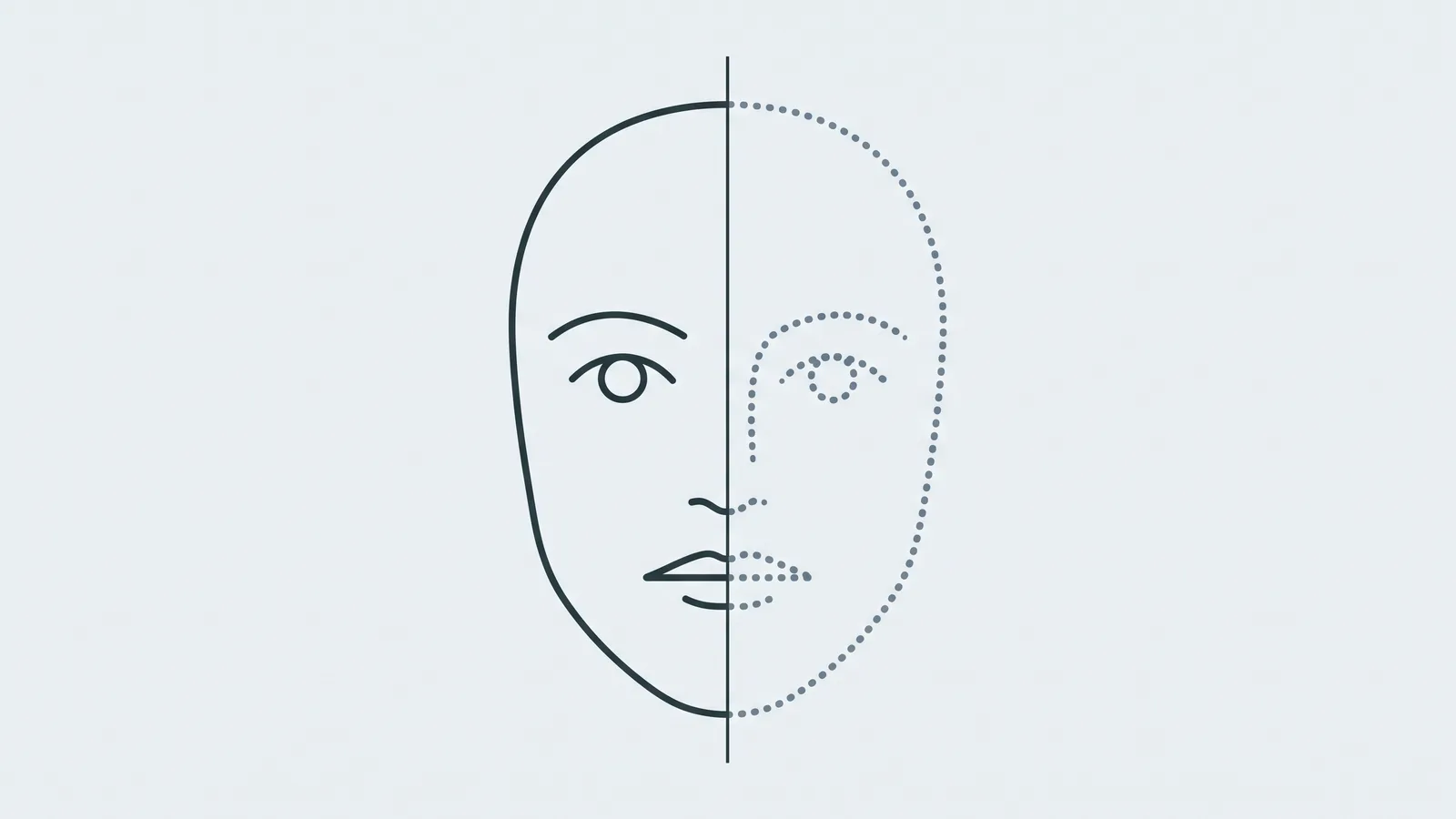
The honest answer is that no tool, rating scale, or person can give you a definitive number, and the reason is not diplomatic. It is structural.
Roughly half of what determines whether someone finds you attractive is their individual taste, which is not predictable from your face. The other half has a real shared component that can be studied. What follows is what that research actually supports, why your own assessment of yourself is unreliable, and what is genuinely worth knowing instead.
Why you cannot answer this yourself
You are the worst-positioned person to assess your own face, for reasons that have nothing to do with confidence or self-esteem.
The mirror problem
You have seen your face mirror-flipped thousands of times and unflipped almost never. Familiarity drives preference, an effect demonstrated repeatedly in psychology, and the version you are familiar with is the reversed one.
The classic demonstration of this is straightforward: people shown both a normal photograph and a mirror-image photograph of themselves tend to prefer the mirror image, while their friends prefer the normal one. Each group prefers the version they have seen more.
This means the face you consider correct is the one nobody else sees, and the face everyone else sees looks subtly wrong to you specifically. That is not a flaw in your face.
Photographs distort
A photograph is not a neutral record.
Camera distance changes your proportions. Photos taken at typical selfie range place the lens close enough that perspective distortion becomes substantial. The centre of the face projects larger relative to the periphery, so the nose reads noticeably wider and longer, and the jaw and ears compress. The same face photographed from further away with a slight zoom looks measurably different, and the distant version is closer to how you appear in person.
Lighting creates structure that is not there. Directional light produces shadow on one side, which reads as asymmetry or as hollowing. Flat overhead light flattens the face. Neither is how anyone sees you.
A still image removes everything that moves. No expression, no eye contact, no speech, no manner. Photographs remove most of the channel through which people actually read a face.
If your photos look worse to you than you feel you look, the photos are usually the reason.
Attention distorts
You have looked at your own features more closely than anyone else ever will. Sustained attention makes small things look large, and any feature examined repeatedly starts to look wrong. This is a documented perceptual effect and it is the engine underneath most appearance fixation.
Nobody else is going to study your philtrum.
What the research actually supports
The honest version, including the parts that are less comfortable.
There is genuine agreement about attractiveness
It would be inaccurate to say attractiveness is entirely subjective. When large groups rate the same faces, they agree with each other far more than chance predicts, and that agreement holds reasonably well across cultures and across age groups, including in young children. There is a shared component and it is not small.
Averageness is the most robust finding
Faces made by digitally averaging many individual faces together are consistently rated as more attractive than most of the faces that went into them. This effect was first demonstrated in 1990 and has replicated well since.
Averageness does not mean plain. It means proportions close to the population mean, which tends to produce a face where nothing reads as unusual. The practical implication is counterintuitive: what people register as an attractive face is often a face without any single feature that stands out.
Symmetry matters, modestly
Symmetry correlates with rated attractiveness, but the effect is smaller than commonly claimed and part of it appears to be carried by averageness rather than by symmetry itself. Artificially perfected symmetry often reads as slightly unsettling rather than more attractive.
Everyone is asymmetric. The question is degree, and most people's asymmetry sits well below what anyone notices in normal interaction.
Masculinity findings are inconsistent
The claim that more masculine male faces are reliably rated as more attractive has not held up well. Results vary considerably between studies and populations, and several widely publicised effects in this area have had significant replication problems.
About half of it is personal taste
This is the finding that changes how you should read every rating you have ever received.
Research on rater agreement finds that shared consensus explains only around half the variance in attractiveness ratings. The remainder is private taste, specific to the individual doing the looking. That component is not predictable from geometry, does not average out, and is not something any measurement captures.
So even a perfect assessment of your face would address roughly half of what determines whether a particular person is attracted to you. The other half is about them.
What actually moves the number
If you take the shared component seriously, the useful question is which parts of it you can influence. The answer is more than people assume, and it is not the parts that get discussed.
Body composition. The largest single lever, and it is not close. Facial fat sits over the jaw, cheekbones, and eye area. Most dramatic before-and-after transformations are primarily this.
Skin. Skin quality affects perceived health, age, and attractiveness substantially. Sunscreen, a retinoid, and treating persistent problems with a dermatologist rather than with whatever is trending.
Sleep. Chronic short sleep produces measurable changes in how others rate faces on health and attractiveness. This is one of the better-evidenced items available and it is free.
Grooming and hair. A cut suited to your face shape genuinely changes your silhouette. Brow shape changes the eye area more than most people expect. Beard shape can build a visual jaw corner your bone structure does not have.
Expression and manner. Almost entirely absent from these discussions and probably the largest omission. People meet you in motion. How your face moves when you talk, whether you make eye contact, and what you do with your face when listening carry an enormous share of what registers. None of it is visible in a photograph, which is exactly why photograph-based assessment underestimates it.
Fit and posture. Clothing that fits and a neck and shoulder line that supports the head both change how the face reads in proportion.
Notice that none of these are bone structure, and bone structure is what almost all the online discussion is about.
What is worth measuring
Measurement is useful for one thing specifically: finding out what is actually true about your face, which is usually less dramatic than what you assumed.
Facial proportions are real quantities with defined formulas. Canthal tilt, gonial angle, facial thirds, midface ratio, symmetry, face shape. These can be measured accurately from a photograph within stated error bounds.
The most common result of measuring properly is discovering that the feature you have been fixating on sits unremarkably within normal range, and that something you had not considered is doing more work. That is genuinely useful. It prevents expensive decisions made on bad information, and it is the opposite of what a rating gives you.
What measurement will not do is answer the question in the title. A proportion is not an attractiveness score, and any tool presenting a composite number as though it were a fact about you is making an aggregation choice and calling it a finding. The weights are doing all the work, and the weights are never disclosed.
Measure your proportions · How we measure
Why asking the internet is a bad way to find out
Rating threads and rating apps are the most common route people take, and they are close to the worst available option.
The raters are not calibrated. No criteria, no rubric, no reconciliation. The same photo gets different answers in different threads.
The incentives are wrong. In appearance-focused communities there is social reward for harshness and a norm treating generosity as dishonesty. This produces systematic downward pressure that has nothing to do with your face.
The scale is anchored wrong. The PSL scale, the most common in these spaces, is anchored against male models rather than the general population, which means it runs two to three points below a general-audience rating of the same person by construction. Full explanation
You are submitting a photo, not a face. Distance, lighting, angle, and expression are doing a large share of the work.
It does not stop. A rating does not resolve the question. It produces a number that needs checking against another number, which is why people who ask once usually ask again.
When the question is the problem
Most people wonder about this occasionally. That is normal and this article exists for those people.
For some people the question stops being occasional, and it is worth being able to tell the difference. Some signals:
- Checking specific features repeatedly through the day
- Photographing yourself under controlled conditions to assess change
- Avoiding photos, mirrors, social situations, or particular angles
- Seeking ratings and then needing another one
- The conviction that one feature is preventing your life from working
- Fixing something and finding attention moves to a new thing rather than the distress resolving
That last one is the most telling. If resolving one concern reliably generates the next, the problem is not located in your face.
Body dysmorphic disorder is a recognised condition, more common in men than the stereotype suggests, and appearance-focused online spaces are an environment where it intensifies. It also responds well to treatment. If any of the above is familiar, a GP or a therapist is a genuinely better use of your time than another rating, and that is not a comment on how you look.
The short answer
You are probably somewhere in the broad middle, like almost everyone, and you look better in motion than you do in your photos, and about half of the answer depends on who is looking.
The parts you can change are mostly not the parts you have been reading about. Body fat, skin, sleep, sleep again, a haircut that suits your face, and how you carry yourself will do more than any measurement will tell you and considerably more than any surgery you are contemplating at 22.
And the question itself, asked repeatedly, has a cost that is usually higher than whatever the answer would be worth.
Frequently asked questions
How can I tell if I am attractive? There is no reliable way to determine this about yourself, because self-assessment is distorted by mirror familiarity, photographic distortion, and sustained self-attention. Other people's ordinary behaviour toward you is a better signal than any rating, photo, or measurement.
Is there an accurate attractiveness test? Not for attractiveness. Around half the variation in attractiveness judgement comes from the individual taste of the rater, which nothing can predict from geometry. Facial proportions can be measured accurately, which is a different and more answerable question.
Why do I look worse in photos than in the mirror? Two effects combine. You are familiar with your mirror image and unfamiliar with the true image, and familiarity drives preference. And photographs taken close to the face distort proportions substantially, particularly enlarging the centre of the face. Both push in the same direction.
Does facial symmetry make you attractive? It correlates modestly, and part of the effect appears to be carried by averageness rather than symmetry itself. Everyone is asymmetric, and most asymmetry sits below the threshold anyone notices.
What is the most attractive face shape? There isn't one. Face shape is useful for choosing a haircut, beard, and glasses. It is not a ranking.
Can you become more attractive? Yes, and by more than most people assume. Body composition, skin, sleep, grooming, hair, fit, and expression all have real effects and are all available without surgery. The things most discussed online, meaning bone structure, are the things you cannot change.
Should I ask people to rate my face? It is unlikely to give you accurate information and it tends to escalate. Rating communities have no criteria, poor agreement between raters, and social incentives that push ratings down.
Related reading The PSL scale explained · Looksmaxxing: what works and what doesn't · Attractiveness test · How we measure a face
See your own numbers.
Upload one photo and get your facial proportions, face shape, and a non-surgical plan in about 60 seconds.
Scan my face