How to Get Hunter Eyes: What Works and What Does Not
An honest breakdown of what actually changes the hunter eye traits, what only changes appearance, and what does nothing. Ranked by effect size, with the surgical options covered plainly.
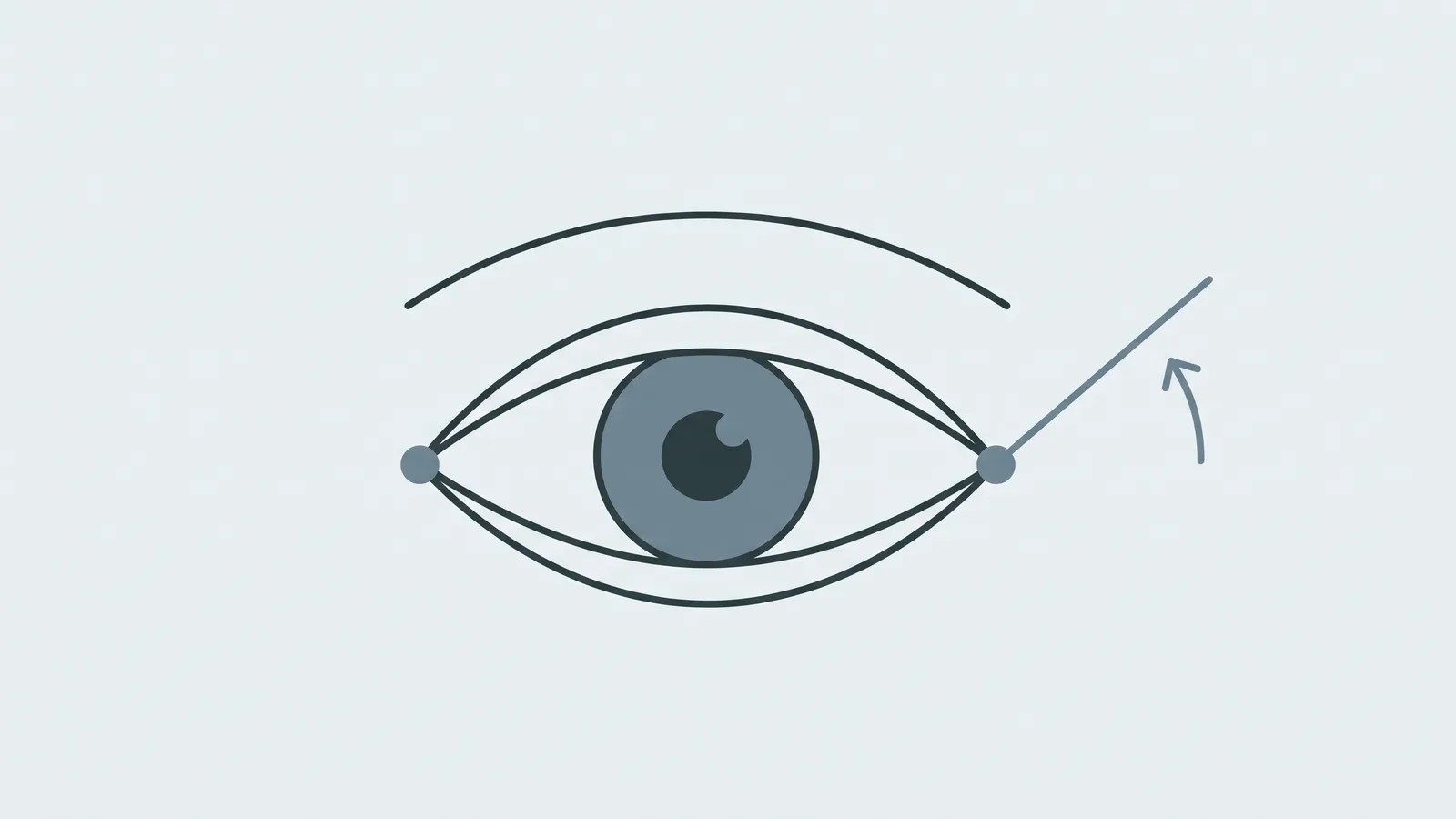
Short answer: the traits are set by the shape and depth of your bony eye socket, and in an adult that does not change without surgery. What does change, sometimes noticeably, is everything sitting on top of the bone.
That is not the end of the article. There is a real list of things that affect how your eye area reads, some of them are free, and one of them is significantly underrated. There is also a longer list of things being sold to you that do nothing.
If you have not read what the term actually describes, start there, because most people trying to change their eye area are targeting the wrong trait: Hunter eyes explained.
First: check whether you actually lack them
This step gets skipped and it should not be.
"Hunter eyes" bundles four separate traits: positive canthal tilt, low brow position, minimal upper eyelid exposure, and a positive orbital vector. Most people have some and not others.
Deciding you lack all four based on looking in a mirror is unreliable. You are seeing a flipped image you have looked at thousands of times, the differences involved are a few degrees and a few millimetres, and mirrors do not let you assess orbital vector at all, since that requires a profile view.
The common outcome of measuring properly is discovering your canthal tilt is unremarkable and that what actually distinguishes your eye area is brow position or lid exposure, which have completely different answers.
Measuring first also stops you spending money on the wrong problem. Measure your canthal tilt
What actually works, ranked
1. Body composition
The largest lever available without a surgeon, and the least discussed in this specific context.
Periorbital soft tissue changes with body fat. At higher body fat the orbital structure is obscured, the upper lid carries more fullness, and the whole eye area reads softer and less defined. Reducing body fat reveals orbital definition that is already there.
This applies to all four traits simultaneously, it is free, and it is the only item on this list that is both structurally effective and completely safe.
If you are carrying meaningful excess body fat and you are researching canthoplasty, you are solving problems in the wrong order.
2. Periorbital swelling
The eye area is one of the first places fluid retention shows, and the effect is larger than people expect.
The contributors are unglamorous and well established: short or poor-quality sleep, high sodium intake, alcohol, and untreated allergies. Chronic allergic rhinitis in particular produces persistent under-eye swelling and darkening, and a lot of people carry it for years without treating it.
Addressing these produces a visible change in the eye area within days. It is not structural, it does not change your canthal tilt, and it is still the highest-yield thing most people can do this week.
If your eyes look different on different days, this is why.
3. Brow grooming
This is the underrated one, and it belongs higher than most people would put it.
Brow position is one of the four traits, and while brow bone projection is fixed, the position and shape of the brow hair is not. The brow and eye are read together as a unit, and where the lower edge of the brow sits substantially changes perceived brow height.
What helps:
- Keep the brow full rather than thin. Thinning a brow raises its visual centre of mass and increases apparent brow-to-eye distance
- Trim or tidy the lower edge carefully rather than plucking upward. Removing hair from underneath raises the brow line, which is the opposite of what you want here
- Take strays from above if you take any at all
- Brow lamination or grooming products can direct hair downward and outward, which lowers the apparent line
This is free, reversible, and takes about ten minutes. It is also the single most effective non-medical intervention for the specific look people are chasing.
4. Sleep position and head elevation
Minor, but real for morning appearance. Sleeping flat on your front encourages fluid pooling around the eyes. Sleeping on your back with your head slightly elevated reduces it.
Temporary, resolves through the day, and worth knowing if you care how you look in the morning.
What changes the appearance medically
These are procedures. They work, they carry risk, and they belong in a conversation with a qualified practitioner rather than with a website.
Under-eye and midface volume
What it addresses: the appearance of a negative orbital vector and under-eye hollowing.
Dermal filler placed to support the tear trough and infraorbital region adds volume where bone projection is lacking. It does not change your orbital vector, which is skeletal. It changes how the transition from eye to cheek reads, which is what people are actually looking at.
Honest caveats: the under-eye is one of the least forgiving areas in aesthetic medicine. Overfilling produces persistent puffiness and a bluish discolouration that can last a long time. Filler in this region can migrate and can hold water. The vascular anatomy around the eye means that intravascular injection here carries serious risk including vision loss, which is why practitioners carry reversal agents and need to know how to use them.
Done by someone experienced, it is one of the more effective options on this page. Done cheaply, it is one of the worst outcomes available.
Brow bone work
What it addresses: brow projection and therefore brow position and lid exposure.
Brow bone augmentation or reduction is performed as part of facial masculinisation and feminisation surgery. Major procedure, significant recovery, and not something undertaken for a marginal aesthetic preference.
The surgical options, per trait
Covered plainly because people search for them and deserve accurate information rather than either promotion or squeamishness.
Canthal tilt: canthoplasty and canthopexy
Canthopexy tightens the existing lateral canthal tendon and repositions the outer corner. Canthoplasty detaches and reattaches it, allowing greater repositioning.
Both are established oculoplastic procedures with decades of clinical use, performed reconstructively for age-related and paralytic laxity and cosmetically for tilt.
The risks are real: asymmetry between eyes, altered lid position, scleral show, dry eye, and a change in eye shape that reads as unnatural. Revision is difficult, and the eye area is unforgiving of imperfect results.
Who to see: a board-certified oculoplastic surgeon, meaning an ophthalmologist with subspecialty training in the structures around the eye. Not a general cosmetic clinic. Ask to see their own before-and-after work on cases resembling yours, and ask directly what their revision rate is. A surgeon who does not push back on a young patient requesting this for aesthetic reasons is not the right surgeon.
Upper lid exposure: blepharoplasty
Upper blepharoplasty removes excess upper eyelid skin. Performed functionally when lid skin obstructs vision, and cosmetically.
The common bad outcome is over-resection on someone who did not need it, producing a hollowed, aged upper lid that is difficult to reverse. Someone in their twenties with normal lid anatomy is generally not a candidate, and a good surgeon will say so.
Orbital vector: rim implants and midface advancement
Infraorbital rim implants add projection beneath the eye. Midface advancement, as part of orthognathic surgery, repositions the maxilla and is performed primarily for functional bite correction.
These are maxillofacial procedures with substantial recovery. The surgeon is a maxillofacial surgeon, and the conversation should begin with whether there is a functional indication.
What does not work
Mewing. Three of the four hunter eye traits depend on the orbital rim and supraorbital ridge, which tongue posture does not touch. The fourth, orbital vector, involves maxillary projection, which is the only theoretical connection, and there is no good evidence for adult skeletal change from tongue posture regardless. Full breakdown
Eye exercises and facial yoga. No effect on tendon position, orbital depth, or bone. Repeated exaggerated expression around the eye can deepen dynamic lines.
Bonesmashing. Deliberately striking the brow or orbital region to induce remodelling. Do not do this. The orbital rim is the bone protecting your eye. The realistic outcomes of fracturing it include nerve damage, sinus injury, double vision, entrapment of the muscles that move the eye, and permanent asymmetry. Of all the places on the face this has been recommended for, this is the worst one.
Tape, patches, and lid-lifting devices. Temporary skin displacement lasting exactly as long as the adhesive.
Supplements marketed for eye area structure. Nothing taken orally repositions a tendon or remodels an orbital rim.
Squinting practice. Occasionally suggested for reducing upper lid exposure. Habitual squinting deepens periorbital lines and does not change lid anatomy.
Cold spoons, jade rollers, and similar. These do transiently reduce swelling, which is a real if small effect, and they do nothing structural. If they help you, fine, but they are in the same category as sleeping well and considerably less effective.
Two things worth knowing about age
Canthal tilt decreases over time. The tendon supporting the outer corner of the eye loosens across decades and the corner descends. This is well documented in the oculoplastic literature and it happens to nearly everyone. If your tilt is lower than you expected and you are past your thirties, that is the likely explanation and it is ordinary.
Midface volume declines. Support beneath the eye reduces with age, which changes how the lower lid sits and increases the appearance of hollowing and a negative vector, independently of the bone.
Both mean that some of what people attribute to bad genetics is ordinary ageing, and some of what younger men are trying to preserve they will lose anyway.
Realistic expectations
Here is the honest ceiling.
Without surgery, you can meaningfully improve how your eye area looks by reducing body fat, resolving periorbital swelling, and grooming your brows well. Combined, that is a real change and it is more than most people expect. It is not a change in your canthal tilt, brow bone, or orbital depth.
With surgery, individual traits can be altered, at real cost and real risk, with results that are difficult to revise.
What you cannot do is convert one eye area into another. The traits are structural, they cluster because they share a skeletal cause, and the cause is not modifiable in an adult by anything short of a surgeon.
The other thing worth saying: the differences involved are small. A few degrees of canthal tilt. A couple of millimetres of brow height. These are real, they do affect how a face reads, and they are dramatically smaller than the weight assigned to them by content produced to be watched.
If you find yourself checking your eye area repeatedly, comparing photos, or feeling significant distress about a feature at this scale, that pattern is common among people who spend time in these communities and it is worth raising with a GP or a therapist. That is not a comment on your face.
Frequently asked questions
Can you get hunter eyes naturally? Not the underlying structure. Reducing body fat, resolving periorbital swelling, and brow grooming all change how the eye area reads, sometimes noticeably. None of them alters canthal tilt, orbital depth, or brow bone projection.
How long does it take to improve your eye area? Swelling responds within days to a week. Body composition changes take months and produce the larger effect. Brow grooming is immediate. Structural traits do not change at all.
Does canthoplasty give you hunter eyes? It addresses one of the four traits, canthal tilt. Brow position, lid exposure, and orbital vector are unaffected by it. It is an established procedure with real risks including asymmetry, dry eye, and altered lid position, and revision is difficult.
Do eye exercises work for hunter eyes? No. The traits depend on bone and tendon position, neither of which responds to muscle exercise around the eye.
Why do my eyes look different in the morning? Fluid redistribution overnight, affected by sleep position, sodium, alcohol, and allergies. Real, temporary, and one of the more controllable factors in eye area appearance.
Is under-eye filler worth it? For appropriate candidates with a genuine hollow and an experienced injector, it can be one of the more effective non-surgical options. It is also one of the easiest areas to make worse, and complications in this region can be serious. It is a medical decision, not a shopping one.
Can teenagers change their eye area? Facial development continues through the teens, so the eye area a 15-year-old has is not the one they will have at 22. That is a reason to wait rather than a reason to intervene. Reputable surgeons decline cosmetic procedures in this region on patients this age for exactly that reason.
Related reading Hunter eyes: what the term describes · Canthal tilt explained · Negative canthal tilt · Looksmaxxing: what works
See your own numbers.
Upload one photo and get your facial proportions, face shape, and a non-surgical plan in about 60 seconds.
Scan my face