Orbital Vector: Positive, Neutral and Negative Explained
What orbital vector means, how to assess yours from a profile view, why it drives under-eye hollowing, and what genuinely changes how it looks.
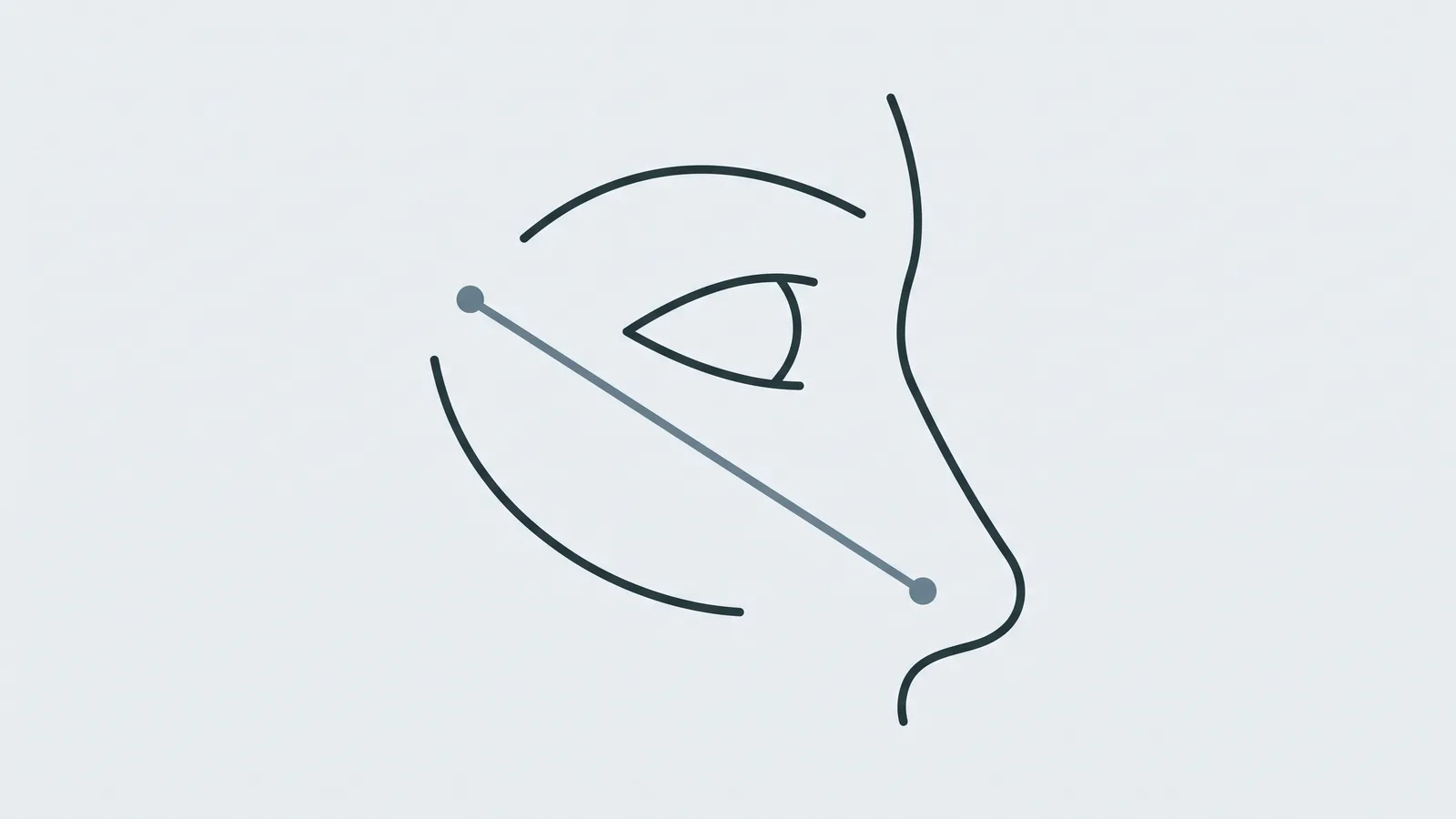
Orbital vector describes whether your eye sits forward of or behind your cheekbone when viewed from the side. If the cheek projects further than the eye, the vector is positive. If the eye projects further, it is negative.
It is one of the more useful concepts in facial aesthetics and one of the least understood, largely because it cannot be assessed from a front-facing photo, which is how everyone tries to assess it.
How it is defined
View the face in profile. Draw a line from the most anterior point of the cornea, meaning the front surface of the eye, down to the most prominent point of the cheek below it.
Positive vector: the cheek is forward of the eye. The line slopes forward as it descends. The eye is well supported by the bone beneath it.
Neutral vector: the two are roughly level.
Negative vector: the eye is forward of the cheek. The line slopes backward as it descends. The eye sits relatively prominent with less bony support underneath.
The determining structures are the infraorbital rim, the bone forming the lower edge of the eye socket, and maxillary projection, meaning how far forward the upper jaw sits. Both are skeletal.
Why it matters
Orbital vector is largely the reason some people develop visible under-eye hollowing early and others never do.
With a positive vector, the infraorbital rim projects forward and supports the soft tissue of the lower lid. The transition from lower lid to cheek is gradual and there is no shadowed step between them.
With a negative vector, the rim sits back relative to the eye. The lower lid has less structural support beneath it, which produces a visible step down from eye to cheek. That step catches shadow, which is what people see as a tear trough, dark circle, or hollow. It is a shadow cast by a structural transition, not a pigmentation problem, which is why concealer and eye creams do so little for it.
It also affects perceived eye prominence. A negative vector makes the eye read as sitting forward, sometimes described as protruding or bulging, and a positive vector makes it read as set into the socket.
And it is one of the four traits bundled into the term "hunter eyes." The others are canthal tilt, brow position, and upper lid exposure. Three of the four, including this one, are determined by the shape of the bony orbit rather than by anything at the surface. Full breakdown
How to assess yours
You need a profile or three-quarter photo. This cannot be done from the front, and it cannot be done reliably in a mirror.
Take a side-on photo in flat, even light, from a reasonable distance rather than at arm's length, with your head level and a neutral expression. Then compare the forward projection of the eye against the most prominent point of your cheek directly beneath it.
Two common errors. Chin position changes everything: tilting the chin up or down rotates the whole relationship and can make a positive vector read as negative. And soft tissue volume in the cheek can partially mask an underlying negative vector in a young face, which is why some people develop hollowing in their thirties that was not there before. The bone did not move. The padding over it reduced.
Any tool offering you an orbital vector from a single front-facing photo is inferring, not measuring.
What changes it
The vector itself is skeletal and does not change in an adult without surgery. What changes is the soft tissue sitting over it, which is what you actually see.
Things that change how it looks
Midface volume. The fat pads supporting the lower lid and upper cheek decline with age, which increases the appearance of a negative vector over time regardless of your underlying bone. This is a large part of why under-eye hollowing worsens through the thirties and forties.
Body fat. Substantial changes alter periorbital and cheek volume in both directions. Losing a lot of weight quickly commonly reveals or worsens the appearance of a negative vector.
Periorbital fluid. Sleep, sodium, alcohol, and allergies affect swelling around the eye, which changes the contour and how sharply the step reads. Real, temporary, and the fastest thing on this list.
Dermal filler. Placed to support the tear trough and infraorbital region, filler adds volume where bone projection is lacking and can meaningfully soften the appearance of a negative vector. This is the most effective non-surgical option and also one of the least forgiving areas in aesthetic medicine. Overfilling produces persistent puffiness and a bluish discolouration that can last a long time, filler here can migrate and hold water, and the vascular anatomy around the eye means intravascular injection carries serious risk including vision loss. Experienced injector or not at all.
Surgical
Infraorbital rim implants add projection directly beneath the eye. Midface or maxillary advancement, as part of orthognathic surgery, repositions the upper jaw and is performed primarily for functional bite correction with substantial effects on the whole midface. Both are maxillofacial procedures with real recovery, and the conversation belongs with a maxillofacial surgeon.
What does nothing
Mewing, on the adult claim. Maxillary projection is the closest theoretical connection to any of this, and there is no credible evidence for adult skeletal change from tongue posture. Facial exercises. Eye creams, for the structural component, though they may help with genuine pigmentation which is a separate cause of dark circles. Bonesmashing, which in this region risks fracturing the bone protecting your eye.
Frequently asked questions
What is a negative orbital vector? The eye sits forward of the cheekbone in profile, meaning there is less bony support beneath the lower lid. It commonly produces a visible step from eye to cheek that catches shadow, which reads as a tear trough or hollow.
Is a negative orbital vector bad? It is an anatomical variation, not a defect. It does predispose to earlier and more visible under-eye hollowing, which is the practical consequence. It has no functional implication.
Can you fix a negative orbital vector? Not the skeletal vector, without surgery. Filler placed to support the infraorbital region can substantially change how it looks, and it is the most effective non-surgical option. Surgical options are rim implants or midface advancement.
How do I know my orbital vector? From a profile photo taken in flat light with your head level. Compare the forward projection of the eye against the most prominent point of the cheek below it. It cannot be assessed accurately from a front-facing photo.
Does orbital vector cause dark circles? It causes the shadowed kind, where a structural step from eye to cheek catches light. Pigmentation and thin skin are separate causes and respond to different treatments, which is why some people find eye creams useless and others find them helpful.
Is orbital vector the same as hunter eyes? No. It is one of four traits the term bundles together, alongside canthal tilt, brow position, and upper lid exposure.
Related reading Hunter eyes explained · Canthal tilt explained · Midface ratio · Facial harmony
See your own numbers.
Upload one photo and get your facial proportions, face shape, and a non-surgical plan in about 60 seconds.
Scan my face